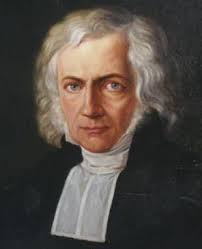
He came out of that brilliant circle in which early Romanticism was born: near him were the Schlegel brothers, Novalis, Ludwig Tieck, and, on the philosophical heights, the young Friedrich Schelling. Among these poets and dreamers Friedrich Daniel Schleiermacher (1768–1834) held a special place. A Protestant pastor and a professor at the University of Berlin almost from its founding, he became one of the creators of a new, modern Protestantism — and tried to speak of God anew in the language of Romantic feeling, moving far from arid rationalism.
For him religion is the relation of man to the universal. Every intuition, he said, proceeds from an object imprinted upon the subject; that object is God. The infinite has left its trace in man — and for that reason man is able to know God at all: not by reasoning about Him from without, but by recognizing that imprint lying in the depth of the one who knows. The Romantics' favorite word — intuition — here becomes a door to the sacred.
But the heart of his theology is feeling. "I feel that I am wholly dependent on the infinite" — that is his formula. Finite man depends wholly on the infinite and attains infinity if he can realize this feeling within himself. Not a demonstrated truth but the lived feeling of absolute dependence sets the soul before God. The notion that "the Kingdom of God is within you" here recovers a significance forgotten by those occupied with quite different things.
That is why he spoke so insistently of what religion is not. It is not metaphysics: it neither explains nor seeks to penetrate the nature of the universal. Nor is it morality: its aim is not the perfecting of the will. The essence of religion is "not in thinking and not in acting, but in intuition and feeling, remaining childlike and passive." It places man at the center of every relation as the condition of all being and the cause of all that comes to be. Religion, he said, is the expression of the infinite.
In this the Eastern Christian experience recognizes something long familiar. To open oneself to the waves of the spiritual ocean, to let oneself as it were vanish so as to become a vessel of divine feeling — of this the hesychast tradition of Athos had always known. By a stroke of genius the Romantic consciousness struggled toward what, for ancient piety, was the norm; and yet this very impulse — the attempt to experience the divine from within rather than to calculate it — was genuine and precious.
He had a second, unexpected gift as well. Translating Plato into German — translations that, with their commentaries, are still reprinted today as the finest — he built a whole system for understanding the ancient text. His hermeneutics, the science of interpretation, long remained a model for European thought: translator and reader must enter into the text of another age, not substituting themselves for it. Thus feeling and understanding met in one man.
Schleiermacher's significance lies in this: he made feeling the organ of the knowledge of God and restored to faith its inner, lived dimension, lost in the disputes of the intellect. He is a bridge between the critical philosophy of Immanuel Kant, the Romantic longing for the infinite that also drove Johann Gottlieb Fichte, and that living theology which is once again learning not to prove God but to feel His presence in the depth of the human heart.