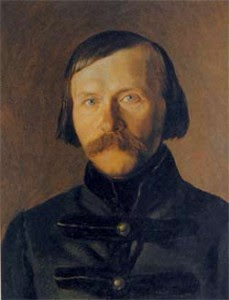
Ivan Kireyevsky was born in Moscow in 1806, but his heart belonged to the quiet estate of Dolbino near Belyov. His father, a man of rare nobility, died in 1812, having caught a fever while nursing captured Frenchmen in his own house. The boy grew up in a circle bound by kinship to Zhukovsky, in the famous salon of his mother, Avdotya Petrovna Elagina, where all of enlightened Moscow gathered. He was a true prodigy: at seven he beat captured officers at chess; in his youth he was fluent in French, German and English, and he mastered the classical languages so well that he could correct scholarly translations of Maximus the Confessor from ancient Greek. For a long time, by his own admission, he lived in the world of German philosophy, where Friedrich Schelling all but replaced the Gospel for him.
As a young man he belonged to the circle of the "archive youths," enthusiasts of philosophy; he travelled to Europe, where he heard and personally knew Hegel in Berlin and Schelling in Munich. On his return he launched a journal with the telling name The European — but it was banned at its second issue over an article of his in which the authorities suspected a dangerous freethinking. The blow silenced Kireyevsky for a long time.
The turning point came in his family life. His wife, a deeply devout woman, a spiritual daughter of the Optina elders, did not quarrel with his idols, but she gave him the writings of the Church Fathers to read alongside Schelling — and it turned out that much of what he had admired was said there "more clearly, more deeply and better." So began Kireyevsky's path to Orthodoxy: he became the spiritual son of an elder, lived for long stretches near the Optina Hermitage, and helped to translate patristic books. Hence his bitter half-smile at Western speculation: "A pitiful labour — to compose oneself a faith."
His central idea became the wholeness of the spirit. The trouble with Western education, he believed, was that man had taken "the abstract logical faculty for the sole organ for understanding truth," whereas reason is only one of the powers of the soul. One must "gather into a single indivisible whole all one's separate powers" — logic and feeling, conscience and the love of the heart — and seek that inner depth where they all merge into "one living and whole vision of the mind." Only to such a gathered, integral person is truth revealed.
Against this, Kireyevsky described with sorrow the fragmentation of Western man, in whom "the conviction of the heart is formed separately from that of the mind": he may pray fervently in church in the morning, then eagerly attend to money matters, then delight in dinner and the opera, then in the family circle — and nowhere do these parts converge into a single personality. He himself understood faith in a new way too: not as trust in another's assurance, but as "an event of the inner life, through which a person enters into essential communion with divine things."
Yet Kireyevsky did not cut Russia off from Europe. On the contrary, he believed that they were called to help one another: European development of logical thought and Russian wholeness were to unite into a single "living, full, all-human and truly Christian enlightenment" — and the word "all-human" he was very nearly the first to utter. His understanding of sobornost was as tender toward the person as that of Aleksei Khomyakov: "every moral victory in the secret depths of a single Christian soul is already a spiritual triumph of the whole Christian world," for "in the spiritual world the building up of each person builds up all, and by the life of all each one breathes."
Kireyevsky defined freedom with remarkable depth — as "the recognition of the holiness of the moral person together with the recognition of the holiness of the eternal moral truths." Here lies the significance of his quiet voice, which loved no dispute: he was the first to sketch a programme that Russian philosophy would take up in earnest only decades later — in the works of Vladimir Solovyov. The call to wholeness of thought, to a faith grown from within life, to freedom as the sanctity of the person, remains one of the purest and most living sources of Russian thought.