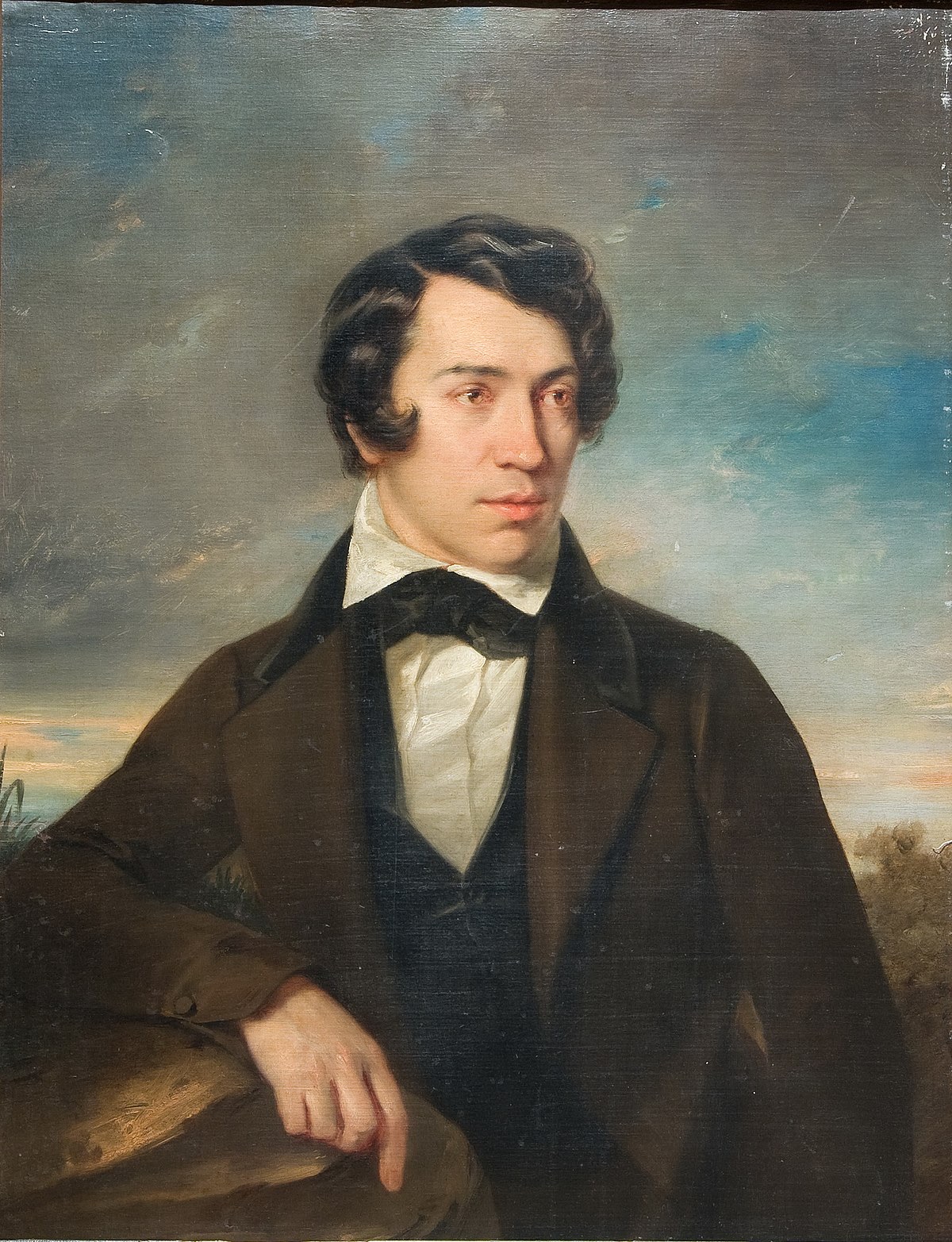
Alexei Khomyakov was one of those people one wants to call a Renaissance man: his contemporaries nicknamed him "the Russian Pico della Mirandola." He wrote beautiful poems and theological treatises, took up painting himself (a self-portrait of his has come down to us), constructed a steam engine that received a patent in London, and compiled a comparative Sanskrit-Russian dictionary. A cavalry officer who distinguished himself in war, he, according to tradition, would raise his saber high in the charge and lead others on — but never brought it down upon a man, calling on the enemy to surrender instead. A strict faster, after the early death of his beloved wife he became almost an ascetic: it was said that robbers hoping to plunder the estate never got the darkness they waited for — a light burned in the window until dawn, because the master was praying all night.
He was a born debater, a genius of dialogue, and a man of colossal erudition. He directed his edge against Hegel: where the German philosopher derived the living fact from a self-moving idea, Khomyakov maintained the opposite — "the concept is what is understood in the one who understands." For him, cognition was not a cold observation of the world from outside, but "the transference of oneself into the object by the force of sincerity and love": we truly come to know another only by loving him and taking him into ourselves. Thus was born the concept of "living knowledge," destined for a long life in Russian thought.
At the heart of his philosophy was the Church — understood not as an external authority and not as an official institution, but as a living organism of love, the Body of Christ. Khomyakov was fond of a simple image: a grain of sand thrown onto a heap remains merely a grain of sand, but a particle assimilated by a living body becomes an inseparable part of the organism and receives new life. So it is with man: a piece of bread is assimilated by the body according to the laws of biology, while a man enters the Church according to the laws of love. He who loves only himself remains a grain of sand in the heap; he who gives himself without expecting a response becomes a living part of the whole.
From this image grows his famous concept of sobornost — that unity in which each person is not dissolved but retains full freedom, because it rests not on coercion but on selfless, self-sacrificing love. And freedom is understood here not as a political slogan, but as a moral choice between love of God and love of self. "Enforced unity is a lie," he wrote, "enforced obedience is death"; genuine unity is possible only in Christ, Who unites Himself with everyone who does not reject Him.
Hence too his analysis of Western Christianity, which has become a textbook example. Romanism is unity without freedom, Protestantism is freedom without unity; and only the conciliar Church calls out: "Let us love one another, that with one mind we may confess." Even the long-standing dispute over the procession of the Holy Spirit Khomyakov explained not so much as a theological error but as a lack of love for the brother's freedom — a loss which, in his view, the West was forced to compensate for by instituting an infallible authority.
At the same time, he by no means confined salvation within the walls of the Church. For him the boundaries of the Church are mysteriously boundless: "he is not His disciple, without knowing it himself, whose heart is open to compassion and love," — every lover of truth is already with Christ. Khomyakov loved Europe, called it "the land of holy wonders," and admired England for its living balance of freedom and tradition. Nor did he flatter Russia: he hated the bondage of serfdom, and in a bitter poem called on his homeland, "black in her courts with black injustice, and branded with the yoke of slavery," to wash herself with the water of repentance, lest a double punishment fall upon her.
Herein lies Khomyakov's greatness: he managed to combine sober criticism with the faith that the conciliar unity of free persons is the highest form of human fellowship. Together with Ivan Kireevsky he laid the foundations of an original Russian philosophy, and his teaching on sobornost and "living knowledge" extends in a direct line to Vladimir Solovyov and the thinkers of the following century. The dispute over the integrity of the spirit and over freedom in love, begun by this "knight of the Church," remains to this day one of the most vital legacies of Russian thought.