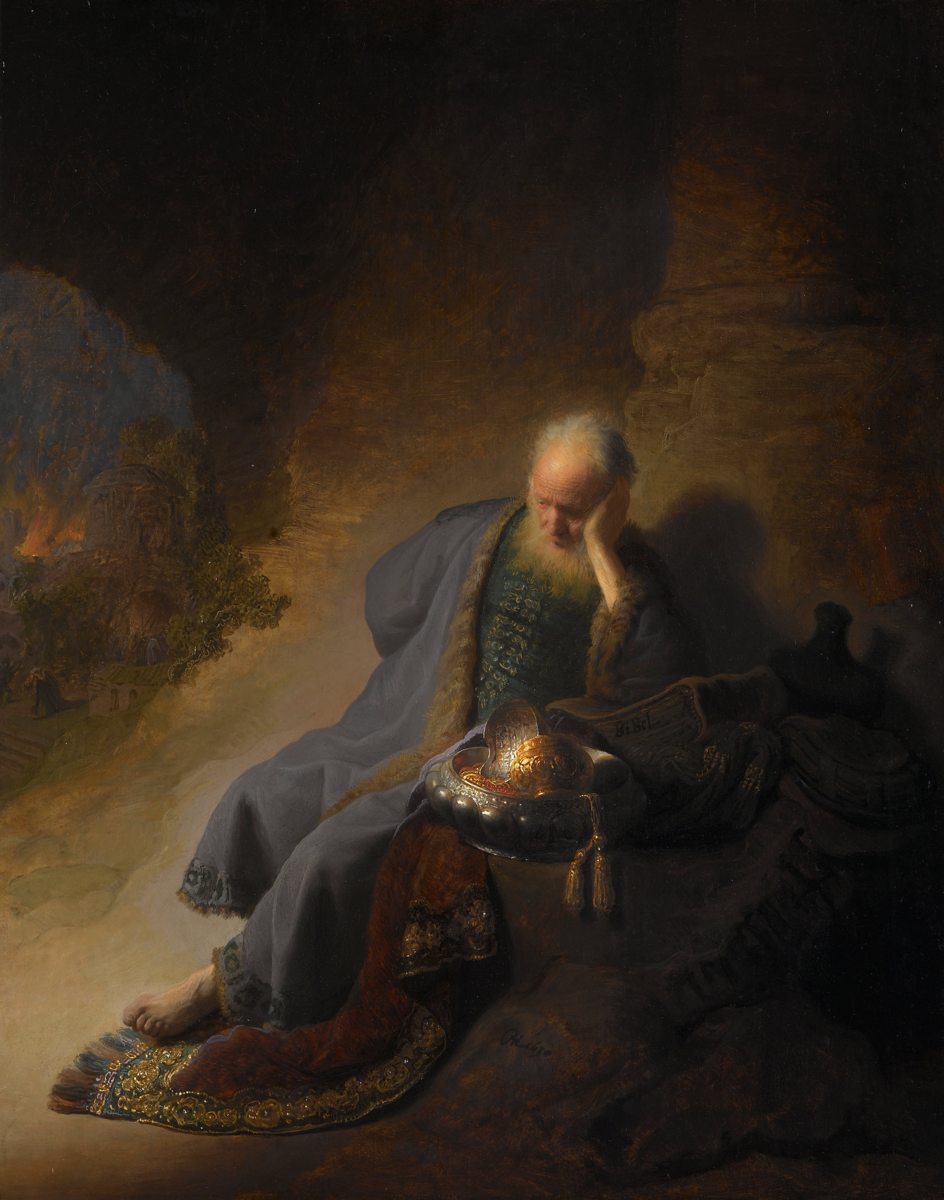
Jeremiah began to prophesy around 627 BC, in the reign of King Josiah, and kept at it for forty years, through five successive kings.
His position was unbearable. The country faced a choice: alliance with Egypt against Babylon, or submission to Nebuchadnezzar. The court, the priests, the false prophets all cried that Judah would stand, that the Lord would defend His Temple. Jeremiah said the opposite: surrender to Babylon — not because Babylon was right, but because Judah had already been defeated spiritually.
He was arrested. He was thrown into a pit of mire. King Jehoiakim burned his scrolls as they were read aloud — and Jeremiah dictated them afresh. He was called a traitor and an alarmist.
In 586 BC Nebuchadnezzar destroyed Jerusalem and the Temple, and the people were carried off into captivity in Babylon. Jeremiah stayed behind amid the ashes — and wrote the Book of Lamentations: five poems on the ruin of the city. Lament as structure, as form, as an attempt to hold meaning together in the midst of chaos.
Jeremiah's central discovery: catastrophe is neither accident nor injustice. It is a logical consequence. The covenant had been broken — not once but systematically, generation after generation. Babylon was not the cause; it was the instrument.
Through Jeremiah the prophetic tradition arrived at what Berdyaev would later say of the Russian revolution: the spiritual catastrophe comes before the physical one. By the time the walls fall, the inside has long stood empty.