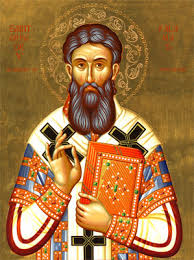
There is a question before which all learned language falls silent: what is God? One can describe a mountain, measure the sea, number the stars — but how is one to name Him Who is greater than every name? In the 4th century, in rocky Cappadocia, the younger brother of a famous theologian, the quiet bishop of the small town of Nyssa, gave an answer to this question, striking in its boldness and humility at once: God is ineffable. His essence cannot be described, cannot be outlined, cannot be grasped. And it is precisely in this admission of one's own powerlessness that man first draws near to the truth.
Gregory of Nyssa (c. 335–394) was a man of two worlds. Behind him stood the full might of Hellenic thought — he knew Plato, read Plotinus, and was well versed in the natural philosophy and medicine of his time. But he laid this brilliant learning at the foot of another mystery. The knowledge of God, he maintained, moves not upward, toward clarity, but inward, toward silence. We know God not as He is in His essence, which is forever hidden, but through His actions in the world, through the radiant traces that are called the "divine names." This is apophaticism — the way of negations, on which every "not that" brings one closer to Him Who is beyond every "that."
But if God is infinite, then the path to Him is infinite as well. Here is born the most beautiful of Gregory's thoughts — epektasis, the eternal ascent. The soul that reaches toward God never attains a limit, because there is no limit. It goes from light to light, and every height attained opens a new, still greater expanse. Blessedness lies not in stopping but in motion itself, in the unending "straining forward." Thus the contemplation of divine beauty becomes not a finish line but an eternal beginning — and heaven turns out to be not the repose of satiety but a living, breathing thirst that is quenched only to be kindled once more.
Gregory was no less bold in his teaching about man. In his treatise "On the Making of Man," he looks upon us not as separate grains of sand but as a single body, as humanity as a whole, conceived by God all at once. For him, man is a microcosm, a small world, a connecting link between earth and spirit: in him flesh and reason, dust and the image of God, meet. And here the body is not a prison, as some of the Greeks supposed, but the soul's companion and the pledge of resurrection. Freedom, reason, speech, immortality — these are the features of that image after which we were created and to which we are called to return.
From this faith in the ineradicable dignity of the creature grew also Gregory's most contested hope — apocatastasis, the expectation of universal restoration. He believed that the torments of hell are not eternal, that evil, having no being of its own, will one day be exhausted like darkness before light, and that all creation will return to its Source. This was not a dogma but a bold hope of the heart, not accepted by the Church as doctrine — yet born of the same depth as all his theology: from the conviction that God is love without limit, just as He Himself is without limit.
The voice of the Cappadocian bishop did not fall silent. His apophaticism would be taken up and carried to its radiant heights by Pseudo-Dionysius the Areopagite; his "divine darkness" would echo in Byzantine hesychasm and in the mysticism of the Latin West. Gregory of Nyssa taught Christian thought a great paradox: the closer one draws to God, the more clearly one sees how incomprehensible He is — and the more fervently one loves. Infinity here is not a cold abstraction but an invitation into an endless journey, where every step is both an attainment and a new thirst. This is his gift to us: to allow ourselves not to know everything, so that we might walk forever toward Him Who cannot be exhausted.