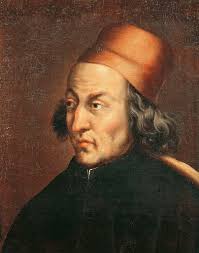
In 1462 the powerful ruler of Florence, Cosimo de' Medici, made a gift strange for a banker. He gave the gifted son of his physician a country estate — and together with it a stack of Greek manuscripts more precious than anything else in the world: the complete works of Plato. So began one of the quietest and yet most fateful labors of the Renaissance. The young man was named Marsilio Ficino (1433–1499), and it fell to him to give Europe back her forgotten teacher.
Before Ficino the Latin West knew Plato almost by hearsay — through paraphrases, fragments, other men's disputes. Ficino translated him whole, word by word, dialogue by dialogue, completing the work by 1468. And then he went further into the depths: he translated Plotinus, Iamblichus, Proclus, Porphyry — the whole great river of late Neoplatonism. And beyond that — the mysterious "Corpus of Hermes Trismegistus," texts that he took for the most ancient wisdom of mankind, an echo of a revelation given to men long before the Greeks. Europe received back a whole lost continent of thought.
Around Ficino there formed a free brotherhood — the Platonic Academy. It had no charter, no membership rolls, no dues; it had conversations. Patricians and merchants, priests and physicians, artists and poets came together — and spoke of the soul, of beauty, of God. This was not a school in our sense, but rather a feast in the Platonic spirit, where thought was born alive, in conversation, beneath the Florentine sky. Out of these conversations, as out of soil, rose a whole art of the Renaissance.
Ficino himself built a well-ordered picture of the world — a ladder of being, along which the spirit descends and ascends: "God, angelic mind, soul, quality, body." On this ladder man occupies the middle and therefore a special place — he is the "center of the universe," endowed with both cognition and free will, the link binding heaven and earth. The highest vocation of the soul is the ascent to God through contemplation. And it is no accident that his chief treatise is titled "Platonic Theology on the Immortality of Souls": all the might of ancient wisdom Ficino turned toward proving that the soul of man is immortal, that it is not extinguished together with the body.
But his most captivating thought is the doctrine of love. In his "Commentary on Plato's Symposium" he made love a cosmic force that binds the universe together. Earthly beauty — of faces, bodies, the arts — is neither a trap nor a sin, but the first rung of a ladder leading upward. The lover, ascending from the beautiful body to the beautiful soul and further to Beauty itself, is seized by a "divine madness" — a sacred rapture in which the soul strains toward union with God. The very phrase "Platonic love" comes from these Florentine conversations.
Ficino also had a bold hope for the reconciliation of faiths. He saw in the different religions not adversaries but stages of a single spiritual tradition, at whose summit stands Christianity — the highest, but not hostile to the "religion of the ancients." This thought of the concord of wisdoms would be passed on to his younger friend, the ardent Giovanni Pico della Mirandola, who dreamed of gathering all the knowledge of mankind into a single synthesis.
In what lies the significance of this gentle priest, who spent his whole life poring over manuscripts? In this: he turned Christian Europe to face beauty and man, without renouncing heaven in the doing. Before him, asceticism was often at war with the world; Ficino showed that the earthly beautiful can be a road to God, and not a defection from Him. His light fell upon the painting, poetry, and philosophy of the Renaissance — and through Pico and Giordano Bruno it stretched on further, into the very heart of the modern age. Cosimo de' Medici's gift, it turns out, went on ripening for centuries.