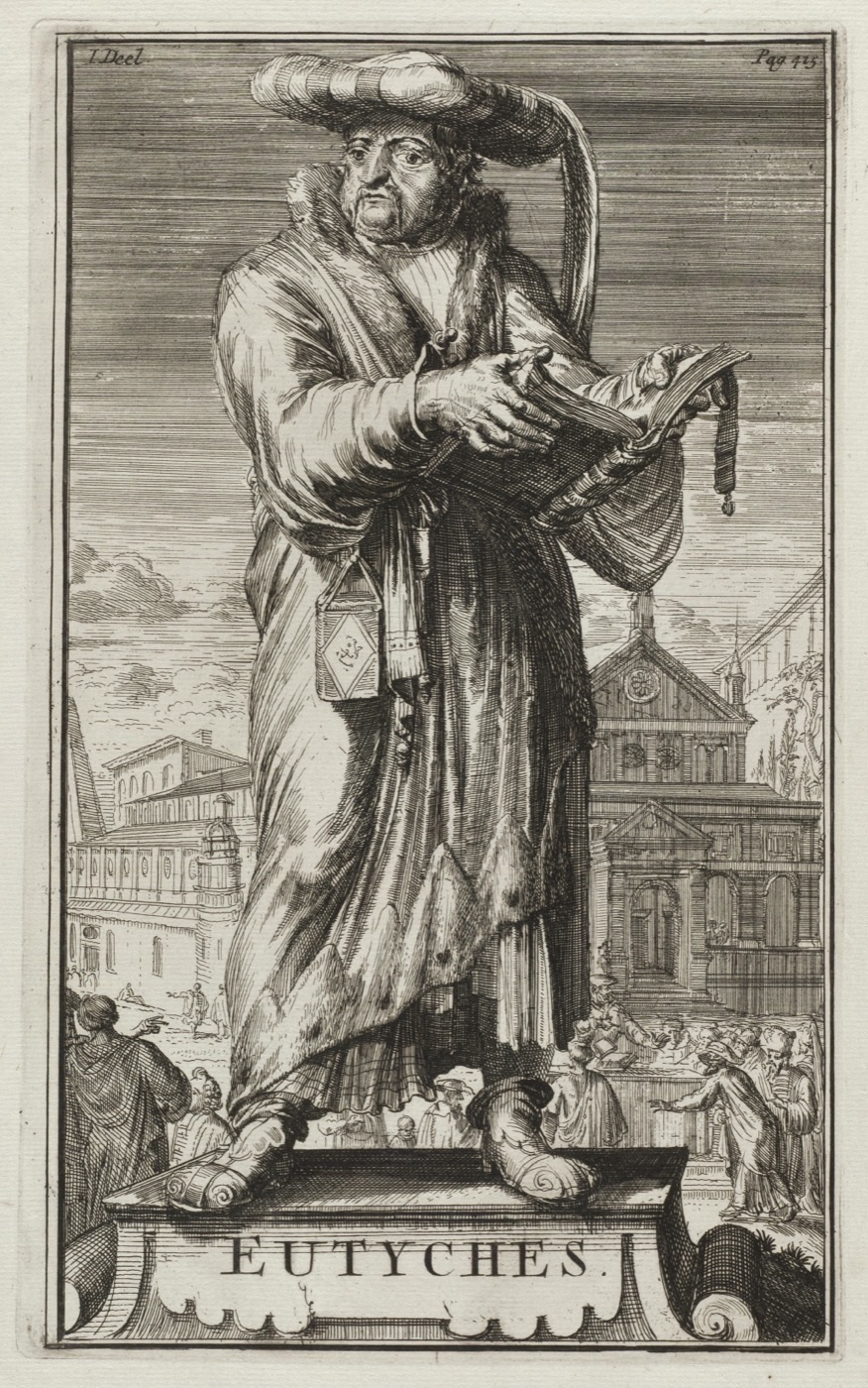
He was born around 380, and by his mature years had become the archimandrite of one of the largest monasteries beneath the walls of Constantinople — more than three hundred monks were under his authority. Eutyches also wielded enormous influence at court: his godson was Chrysaphius, the all-powerful favourite of the emperor Theodosius II. A faithful disciple of Cyril of Alexandria, he fiercely defended the unity of Christ against Nestorius, who divided God and man in the Saviour too sharply. But his fight against one extreme drove him into the very opposite.
Eutyches' formula ran thus: the Lord was of two natures before the union, but of one nature after the union. Christ's humanity, according to this teaching, was absorbed by His divinity, dissolved in it like a drop of honey in the sea. The Saviour's body ceased to be consubstantial with ours: it was deified at the very moment of the Incarnation and lost its genuine, full humanity. Thus was born Monophysitism — from the Greek words μόνος, "one," and φύσις, "nature."
In November 448 the patriarch Flavian convened a synod in the capital and summoned Eutyches to give account. The archimandrite persisted in his formula — and was condemned, deposed and excommunicated. Flavian informed Rome, and Pope Leo I the Great composed his famous Letter to Flavian (the Tomus Leonis, 449) — one of the most important theological texts of the age. It affirmed that in Christ there abide two full natures, each acting in its own order, yet inseparably united in one Person.
Yet through his godson Chrysaphius, Eutyches secured the convening of a new council. In August 449, at Ephesus, Dioscorus of Alexandria acquitted Eutyches, deposed Flavian, and would not even allow Leo's letter to be read aloud. The patriarch Flavian was beaten during the very session and soon died of his injuries. Pope Leo called this assembly the Latrocinium — the Robber Council — and that name has stuck to it in history.
The resolution came quickly. In 450 Theodosius II died, and the new emperor Marcian convened the Fourth Ecumenical Council at Chalcedon (451). The council condemned Eutyches, deposed Dioscorus, and adopted a definition of faith that became the foundation of all later Christology. The Chalcedonian Definition confesses Christ in two natures, united in one Person in four ways: ἀσυγχύτως — without confusion, ἀτρέπτως — without change (this against Eutyches), ἀδιαιρέτως — without division, ἀχωρίστως — without separation (this against Nestorius). The definition is given apophatically: the mystery is outlined through what it is not.
The condemnation of Eutyches turned into a profound schism that remains unhealed to this day. The churches of Egypt, Ethiopia, Armenia and Syria rejected Chalcedon — not because they shared the crude teaching of the "drop of honey," but because they saw in the very formula "in two natures" a dangerous concession to Nestorianism. The Oriental Orthodox churches prefer the term Miaphysitism: one nature of the God-Man, but without mixture, without fusion, without change. The dispute has already lasted fifteen hundred years.
Half a century before Chalcedon, Gregory the Theologian gave the key to this whole drama: "What has not been assumed has not been healed" (τὸ ἀπρόσληπτον ἀθεράπευτον). If Christ did not assume the whole fullness of human nature — with body, soul and will — then He did not heal and save the whole man. Herein lies the question of the Incarnation for whose sake the councils contended. Chalcedon, standing exactly midway between Nestorius and Eutyches, answers: God became fully man without ceasing to be fully God. This mystery cannot be rationalised — it can only be carefully outlined at its edges.