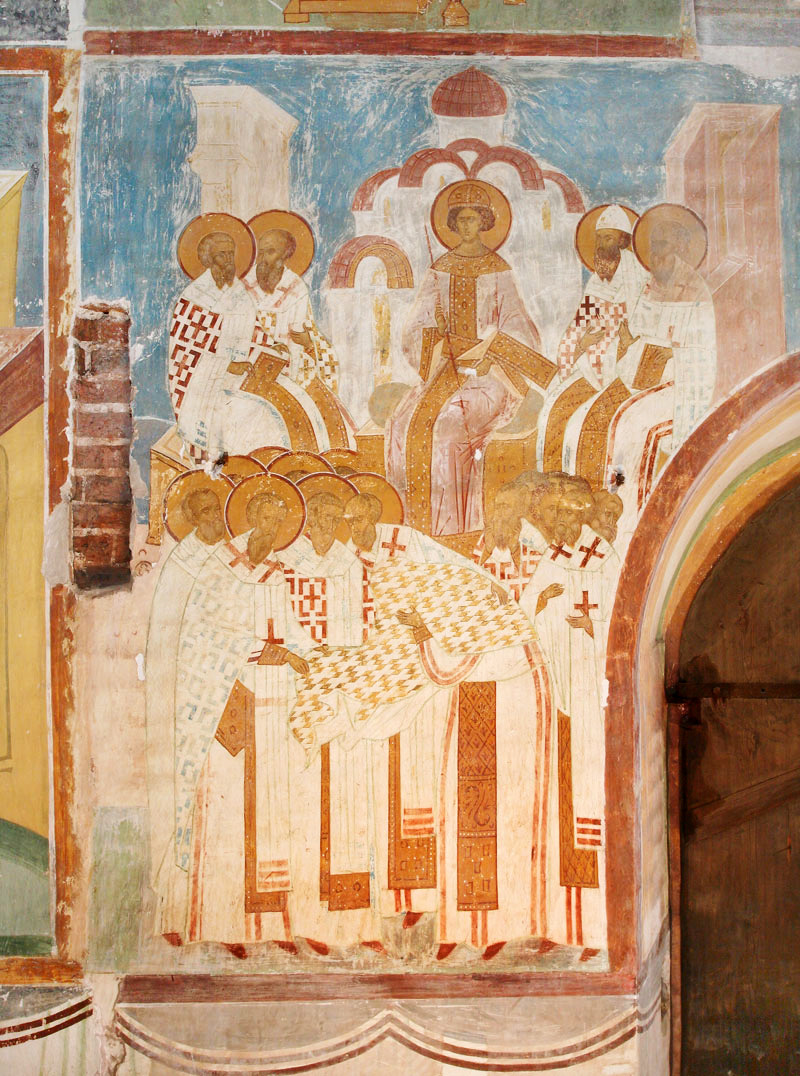
Nestorius was born around AD 386 in Germanicia, a small town in the southeast of Asia Minor. He learned his theology in Antioch, and that was a school apart: here Scripture was read literally, soberly, with a distrust of allegory, and with a firm hold on the genuine humanity of Christ — on the fact that He truly suffered, truly was a man. Nestorius became a monk and a brilliant preacher, and in 428 the emperor raised him to the patriarchal throne of Constantinople. This was the second most important see in the Christian world. He was no marginal figure from the provinces, but the head of the capital's Church.
The conflict flared up almost at once. Nestorius backed his chaplain, who preached against the customary naming of Mary as Mother of God (in Greek Θεοτόκος — "she who gave birth to God"). The word troubled Nestorius: how can God, eternal and unchanging, have a mother? How can the Creator be born? He proposed a cautious substitute — Christotokos (Χριστοτόκος): Mary gave birth to Christ, the man in whom the Divine Word dwelt. To God one cannot ascribe birth, nor a cradle, nor death on the cross — all of this belongs to the human nature.
Behind the word stood a principle. Nestorius so feared to blend God and man together in Jesus that he drew the two natures apart almost to the breaking point: the Godhead, he said, dwells in the humanity of Christ — but dwells there as in a temple. His critics heard in this a dangerous division: it seemed to make Christ into two subjects, as if God and man stood side by side, merely closely joined. And if so — then Who was it that died on Golgotha? Only a man? Then the cross does not save.
His chief opponent became Cyril, archbishop of Alexandria. He insisted on the opposite: in Christ there is one Person, one Hypostasis, one and the same He. The two natures, divine and human, are joined not as neighbor to neighbor, but in the unity of the Person himself — so that everything can be said of the one Christ at once. This is precisely why Mary is Mother of God: she gave birth not to "a mere man," but to that one Being who is God become man. To reject the word "Mother of God," for Cyril, meant tearing Christ in two.
The dispute was settled at the Third Ecumenical Council at Ephesus in 431 — in a city that held a church dedicated to the Mother of God. Cyril opened the sessions without waiting for the Antiochene delegation allied to Nestorius; the council condemned Nestorius and deposed him. The Antiochenes, arriving, convened their own counter-council and condemned Cyril in turn — for a time schism set in. But the emperor sided with Ephesus. Nestorius was sent into exile — first to a monastery, then to the far oasis of Hibis in the Egyptian desert. There, around 451, he wrote his apology, the Bazaar of Heracleides, insisting that his teaching had been distorted and that he himself believed in one Christ. He died in exile.
History, however, did not end with his condemnation. His followers, the Church of the East, went beyond the borders of the empire — into Persia, and farther east still. Their mission reached as far as India, where it merged with the ancient community of the Christians of the Apostle Thomas in Kerala, and as far as China itself: in 635 a preacher named Alopen arrived in the Tang capital of Chang'an, and the emperor permitted his preaching. In 781 a stone stele was raised there, describing in Chinese and Syriac a century and a half of Christianity in the Middle Kingdom. Between the 9th and 14th centuries this Church was, by geography, the largest Christian confession in the world — the trace of a teaching that the councils had rejected.
Behind the subtle quarrel over words stood an utterly concrete question: how, in the one Jesus Christ, are God and man joined? If the two natures merely touch, if God only dwells in the man as in a lodging — then the Incarnation loses its radical force. God then did not become man, but only drew near to him; and salvation turns out to be not the transfiguration of human nature, but a moral imitation of an example. The Council of Ephesus answered otherwise: God truly became man, and therefore Mary is truly the Mother of God — because she gave birth to the one Person of God, who had made himself one of us.