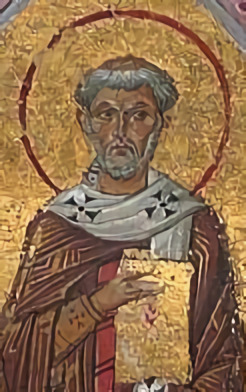
In the middle of the fifth century the Western Roman Empire was living out its last decades without yet knowing it. Emperors in Ravenna succeeded one another every few years, rarely dying a natural death; the real power was held by barbarian commanders in imperial service; the treasury was emptying, the frontiers were leaking. It was precisely at this hour, when the old world was losing the ground beneath its feet, that a man came to the fore whose authority depended neither on the army nor on the palace — the bishop of Rome, Leo I, whom posterity would call the Great.
Two episodes made him an almost legendary figure. In 452 the hordes of Attila's Huns, having already ravaged the north of Italy, moved on Rome. There was nothing with which to stop them — and it was not a general who went out to meet them, but the pope. What they said at the city walls no one knows for certain, but Attila turned back. Three years later, in 455, the Vandals of Geiseric approached Rome. This time Leo could not prevent the sack, but he won a concession that was worth a great deal in that age: the city was plundered, but not burned, and no massacre was carried out.
From these two ventures beyond the gates a new image of power was born. While the secular rulers grew weak and replaced one another, the bishop of Rome did, in full view of all, what the emperor ought to have done — he defended the city and spoke in its name. This observation — that spiritual authority is able to fill the vacuum left by a collapsed political force — lay at the foundation of the whole medieval papacy. The model that Leo embodied would work for a thousand years.
But the true measure of this figure lies not in diplomacy but in theology. In those same years the Christian world was torn by the dispute over how God and man are joined in Christ. Some, following Nestorius, separated the divinity and the humanity in Him too sharply; others, on the contrary, like Eutyches, dissolved the human nature in the divine without remainder. The question was no matter for the schoolroom: on the answer depended what salvation itself means and to Whom the Church prays.
At the height of this dispute Leo composed a letter — the so-called "Tome," addressed to the bishop of Constantinople. In it he formulated, with Roman clarity, what would become the doctrinal norm: in the one Christ two full natures, the divine and the human, are united without confusion and without division, and each acts in its own way, yet in one Person. This was no abstract formula but an attempt to hold the very heart of the Christian faith — that God truly became man without ceasing to be God and without absorbing the human.
In 451, at the Council of Chalcedon — the largest church assembly of that age — Leo's "Tome" was read aloud before hundreds of bishops. Tradition has preserved their response: "Peter has spoken through the mouth of Leo." This was more than praise of eloquence. Behind the words stood an acknowledgement that the voice of the Roman see, heir of the apostle Peter, sounds with a special authority. The Chalcedonian Definition of the two natures, which lay at the foundation of both Orthodox and Western Christianity, grew in large measure out of this very letter.
Thus in one man two stories of a single age came together. At the walls of Rome he shielded the dying city with his body — and at the council he fixed in words what the Church would still believe about the Incarnation fifteen hundred years later. Leo the Great remained in history as the man who, on the ruins of imperial power, showed that when force collapses, the word remains — and it can prove firmer than stone.