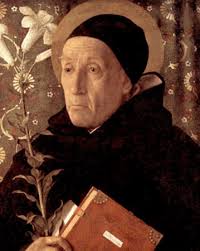
At the beginning of the fourteenth century a German speech such as theology had never known rang out from the lecterns of Cologne and in the dim refectories of women's convents. A learned Dominican, accustomed to the Latin rigour of the Paris school, suddenly began to speak with simple nuns in their own tongue — and that tongue flared up. Meister Eckhart sought words not in order to describe God from afar but in order to lead his listener to the very edge, beyond which all words end. There he uttered the boldest of his distinctions — and came within a hair of plunging into the abyss into which he gazed so intently.
The distinction is this. There is God — He whom we confess, the Creator, who reveals Himself as Trinity, to whom prayer is addressed. And there is, in Eckhart's word, the Godhead (Gottheit) — the depth of the Divine essence itself, silent and bottomless, which he dared to call an "abyss" and even a "nothing." Care is needed here, for thought easily stumbles: Eckhart does not say that behind the living God there hides some impersonal background. God eternally is a Person, and Personhood does not "accrue" over something impersonal. The mystic was only trying to say what apophaticism had coined before him: it is truer to say of God what He is not than to ascribe to Him our concepts. The essence of God is deeper than any name we have for it — and it was this inexhaustibility that, with German bluntness, he called an abyss.
He took up this path of silence from the hands of Pseudo-Dionysius the Areopagite, for whom the ascent to God was an immersion in a "brilliant darkness." And further back still stands Plotinus, with his One that is above being and mind and remains unsayable. But the German master took a step the Greeks did not dare to take: he carried this abyss inside the human being, unfolding the Neoplatonic ladder of descent into a drama played out in the silent core of the soul.
For in the depth of each of us, Eckhart taught, there smoulders a spark of the soul (Seelenfünklein) — a point akin to the Godhead itself, untouched by time, by sin, or even by a name. And when the soul purifies itself down to this spark, the impossible is accomplished within it: the birth of the Word. Not the memory of a distant event but a present, eternally continuing birth of God in the human being. "The Father begets the Son," he dared to say, "and He begets Him in my soul." Here Eckhart approached the most dangerous line, and the Church later condemned a number of his positions: it was all too easy to read these words as if the boundary between Creator and creature were being erased. He himself, it seems, meant not a dissolution but a supreme nearness, granted by grace.
For this birth to be accomplished, there must be releasement (Gelassenheit) — and in it lies all that is distinctive in Eckhart. This is not harsh fasting and not a hair shirt; outward works he pushed down to the lower rungs. Releasement is an inner emptying: to let go of the images of the senses, the constructions of the understanding and, at last, the very clinging "I" with its wanting and its possessions. To be empty, poor, imageless — this means to make room, and that room is instantly filled with God. Here Eckhart is closer to the thirst for deification in Gregory of Nyssa than to the clear blueprints of school theology, where everything is dissected and named.
A papal bull condemned twenty-eight points shortly after his death, and Eckhart's name passed for a long time into the shadows — to return centuries later. His abyss and his spark would be recalled, each in their own way, by the German mystics, by Luther, and then by Hegel, Schelling and Heidegger, who caught a kindred note in the medieval preacher. Herein lies the significance of the Meister: he carried apophaticism to the limit where theology almost breaks off into silence, and he paid for the audacity. He remains a reminder of the fine line — between the humility that keeps silence before the inexhaustible mystery of God, and the pride that imagines this mystery to be its own depth. At the very edge of the precipice these two stand almost side by side.