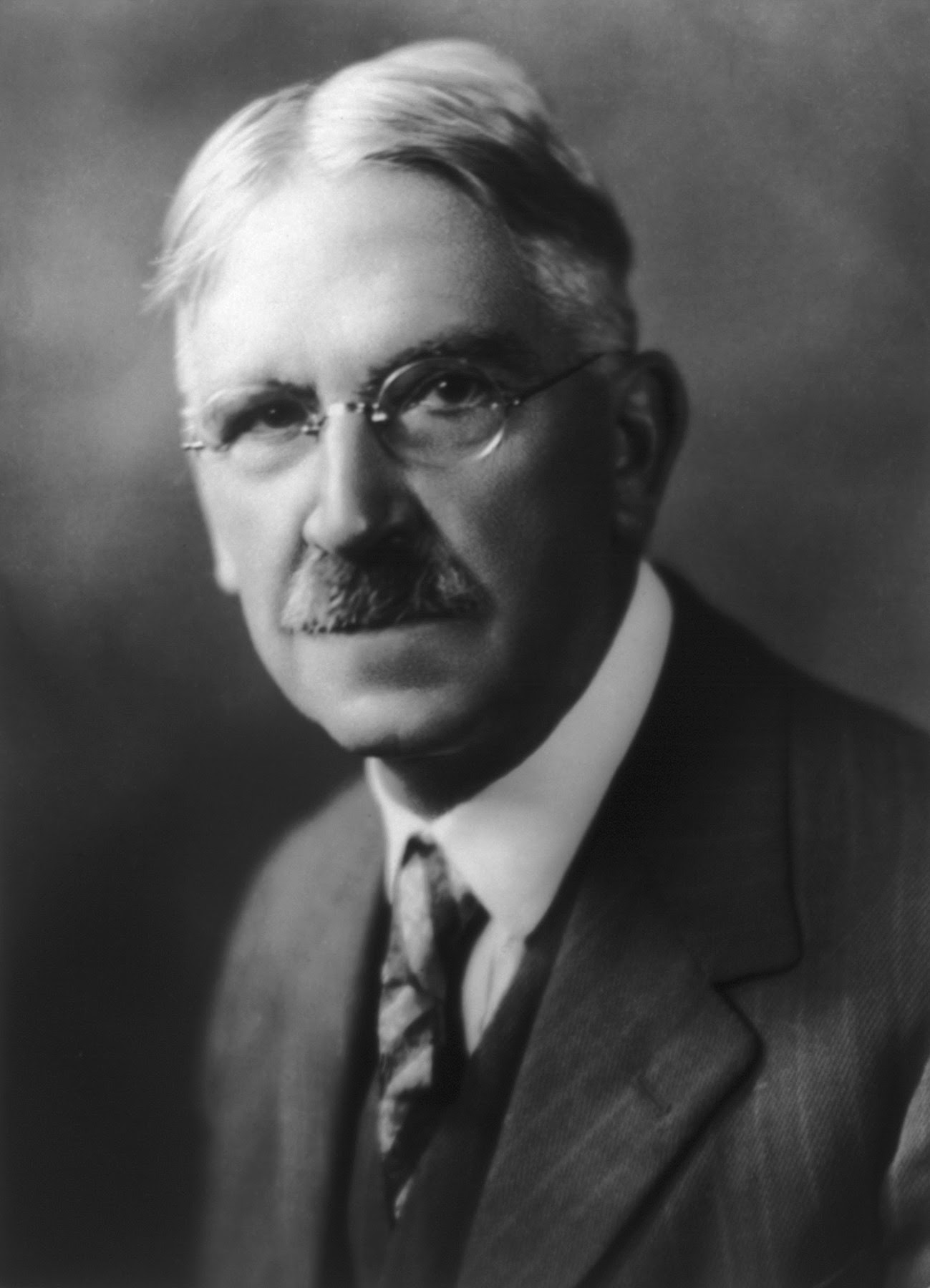
Imagine a child reaching toward fire for the first time. No lecture on the properties of flame will teach him as one scalding experience will. It is with this simple and stubborn thought that the philosophy of John Dewey (1859–1952) begins — an American from Vermont who spent half a century trying to restore to thinking its lost meaning: to be not a mirror of the world but an instrument with which the human being remakes that world. Dewey taught at Michigan, Chicago and Columbia, opened experimental schools, and tested his ideas not on paper but on living children. For him, a philosophy cut off from action was an empty ringing.
His teaching is usually called instrumentalism — a particular version of pragmatism. Ideas, concepts and scientific laws Dewey refused to regard as copies of reality. They are tools, working instruments, with which we resolve difficulties. A hammer is good not because it is "true" but because it drives in a nail. In just the same way, a thought is valuable not in itself but for leading us out of the dead end of a problematic situation to a new, more stable equilibrium with the world. Truth, for Dewey, ceases to be a cold correspondence to things and becomes that which works, that which has proven itself in action.
At the centre of everything stands the notion of experience. But Dewey's experience is not a thin film of sensations on the surface of consciousness, as it was for the earlier empiricists, the heirs of John Stuart Mill. Experience embraces the whole of human life — labour and dreams, illness and war, the heritage of culture — fused into a single organic whole. The human being does not contemplate the world from the side; he is immersed in it up to his neck, he continually acts and suffers the consequences of his actions. To think is to rebuild experience when the accustomed course of things has broken down.
Here Dewey was the direct heir of one great idea of the age. The evolutionary thinking of Charles Darwin taught him to see the living creature not as a finished automaton but as an organism that survives only by adapting to its environment and remaking it to suit itself. Reason, for Dewey, is the highest form of such adaptation, an instrument of survival grown out of that same struggle for existence of which the biologists wrote. And yet he decisively parted ways with Herbert Spencer: evolution does not justify the power of the strong but calls the human being to become a co-author of his own future.
Out of this is born his famous theory of thinking as problem-solving. Dewey broke the living act of thought down into five steps: we run up against a difficulty; we determine what exactly the problem is; we advance possible solutions; we think through their consequences by reasoning; and, finally, we test the hypothesis in experience. This is how the scientist thinks in the laboratory — and this, Dewey maintained, is how any person and any schoolchild ought to think. "Learning by doing" — such was his motto, which overturned the pedagogy of the twentieth century.
But the heart of his philosophy was democracy. Education Dewey considered the chief instrument for giving citizens equal opportunities and forming a democratic consciousness. Democracy, for him, is not merely a way of voting but a mode of shared life, in which people cooperate reasonably and gradually improve their society, without waiting for revolutions and without submitting to ready-made truths handed down from above. The school was for him the embryo of such a society in miniature.
Herein lies the enduring significance of Dewey. He restored to thought its earthly, working honesty: knowledge is not there to be admired from afar but to make life fuller and more humane. Each time a teacher declines to dictate and lets a pupil solve a problem for himself, this quiet philosopher from Vermont is invisibly present in the classroom — the man who believed that the freely thinking human being and the free society grow from one and the same root: from living, genuine experience.