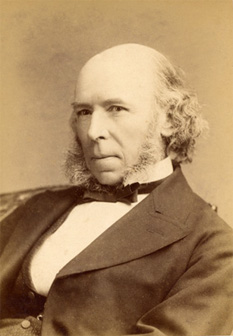
Closing the line of English thinkers is Herbert Spencer (1820–1903), a man of remarkable independence. He refused to study at university, declined a professorship in London, and refused membership in the Royal Society. An engineer, inventor, and journalist, upon receiving an inheritance he devoted himself entirely to scholarly work — and built his entire system of thought on his own, athwart the academic institutions.
The idea of evolution is usually associated with Darwin, but "The Origin of Species" appeared later, while Spencer had already put forward the idea of development earlier — in "The Developmental Hypothesis" (1852) and "The Principles of Psychology" (1855); it was at this time that he conceived "First Principles" of his synthetic philosophy. Evolution, in his understanding, is a transition from an indefinite, incoherent homogeneity to a definite, coherent heterogeneity, in which matter grows concentrated while motion undergoes a parallel transformation. In society this is the path from primitive forms to a complex, multi-part state.
He advanced the idea of continuous progress. Setbacks occur, but the overall line is one of steady ascent; this is the optimism of the second half of the nineteenth century. Evolution, in his thought, can only culminate in the establishment of the greatest perfection and the fullest happiness, which by definition is unattainable — and so this movement will be eternal.
The most subtle thing in his thought is the union of freedom and law. Each person, singular and unrepeatable, acts freely — and in this Spencer is close to the spirit of liberalism, which, both in formal logic and in morality, upheld not the mass, not humanity, but the individual person. Yet the species as a whole develops according to definite laws of evolution. Personal freedom within a general lawfulness — that is his formula, and it is precisely here that he fundamentally parts ways with those who wished to have "the knowing lead the unknowing": the free development of each person, of itself, spontaneously, coalesces into a movement toward the greatest happiness.
Hence his books with their telling titles — "The Man versus the State" (1882) and the later "The Principles of Sociology." Society exists for the individual, not the individual for society; the development of society depends on the degree to which the individual person realizes himself. He distrusted state intervention. In this he is the direct opposite of all doctrines that sacrifice the individual to the whole.
Spencer also had his own religious thought. He was personally acquainted with William Hamilton, who introduced the English to German Romanticism, and spoke of the Unknowable. For him, science and religion were two poles: as one deepens, so does the other. Science merely purifies religion of the accidental and the magical, while the Unknowable itself — an absolutely existing first principle — remains beyond the reach of knowledge, for the purpose of religion is not to know but to stand before the mystery.
Spencer's significance lies in the fact that he was the first to dare to transfer the idea of development from nature to everything at once — to the psyche, to society, to morality — and to gather this into a single "synthetic" picture of the world, in which accumulated experience is transformed into ready-made moral norms for new generations. Alongside the positivism of Auguste Comte and the defense of individual liberty in John Stuart Mill, his evolutionism became the powerful pillar on which the age's faith in unstoppable progress long rested — together with all its illusions and blind spots.