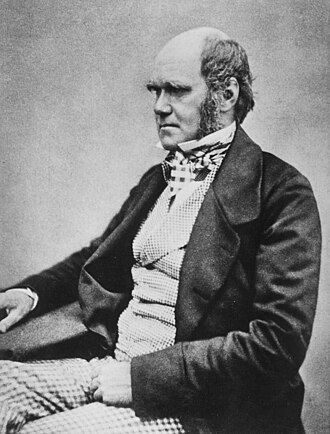
A twenty-two-year-old graduate of a theology faculty, who had come within a step of becoming a country parson, boarded a small sailing ship, the Beagle — and stepped off it five years later a man destined to overturn humanity's conception of itself. Charles Robert Darwin (1809–1882) was born in the English town of Shrewsbury, into the family of a physician, the grandson of the natural philosopher Erasmus Darwin. He called his voyage around the world "the most important event of my life": studying the geology, fauna and flora of South America, the young naturalist gathered collections that slowly, year by year, blew apart from within the familiar picture of an unchanging world created once and for all.
On his return, Darwin nursed his conjecture for two decades, dreading its consequences. He began developing the theory as early as 1837, but resolved to make it public only in 1859, in a book whose full title speaks for itself — On the Origin of Species by Means of Natural Selection. The idea was deceptively simple. Living creatures are born in greater numbers than the earth can feed; among them a struggle for existence goes on; and those whose structure, instincts and abilities answer a little better to the conditions of their environment more often survive and leave offspring. Thus nature, without any design or plan, slowly selects the fortunate and rejects the unfit.
At the foundation of his teaching lie three forces. Variation scatters new, unpredictable traits among the offspring. Heredity fixes them and passes them on. And natural selection plays the part of an invisible sculptor, chiselling away everything unadapted. Over vast stretches of time tiny differences accumulate — and one species imperceptibly passes into another. Darwin backed this with an avalanche of evidence: the experience of breeders, the geographical distribution of species, fossil remains, the similarity in the structure of bodies, and the facts of embryology.
The blow struck by this book was above all a philosophical one. Darwinism undermined the creationist picture of the world, in which each species had been separately created and was unchanging. The human being ceased to be the crown of a special creation and was inscribed into the common stream of living nature as one of its branches. Darwin himself, who had begun as a believer, admitted that "disbelief crept" into his soul slowly and inexorably. His contemporaries rightly felt in his teaching the strongest of blows against the metaphysical, frozen view of nature.
The philosophical consequences spread in widening circles. The idea of struggle and the survival of the fit was at once taken up by Herbert Spencer, who hastily transferred it to society — and so was born the disputed social Darwinism. The pragmatist John Dewey, by contrast, drew from Darwin a subtler lesson: if reason arose as an instrument of adaptation, then thinking too must be understood not as a mirror of eternal truths but as a living tool for solving problems. And Henri Bergson entered into dispute with the mechanics of selection, opposing to it a creative evolution driven by the inner impulse of life.
Darwin was not a philosopher and built no systems. But by establishing in science the principle of historicity and development, he rebuilt the very ideals of explanation. After him it became impossible to think of the living as finished and immobile: every form now bore upon it the imprint of its origin, of its long and dramatic history. The evolutionary view poured out of biology into psychology, into sociology, into the human sciences.
Herein lies the colossal significance of the quiet naturalist from Shrewsbury. He did not merely discover the mechanism by which species develop — he restored to the world the dimension of time and becoming, showing that the human being and all living things are not finished products but the outcome of a long road. With Darwin begins modern self-awareness: anxious, stripped of its former supports, but for the first time seeing itself as part of a vast, moving, unfinished nature.