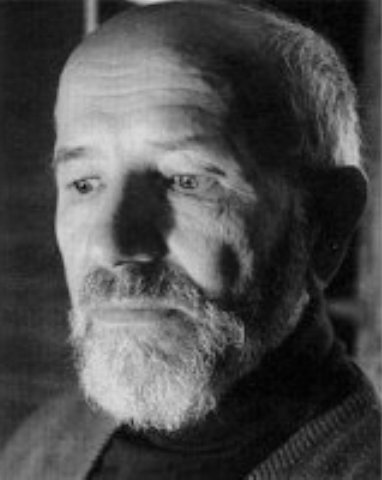
To translate Heidegger's Being and Time into Russian, it is not enough to know German — one must forge anew the very language of Russian philosophy, finding words where none yet exist. Vladimir Bibikhin (1938–2004) took up exactly this task and became the chief conduit of German thought into Russian speech. But he was a translator in a far broader sense: his whole life he translated the inexpressible — world, being, silence — into a language in which one might think about them.
He did not come to philosophy by a direct road. He graduated from the Institute of Foreign Languages, taught the theory of translation, and defended a dissertation on "the semantic potentials of the linguistic sign" — and only later, already a mature man, did he come to the philosophy faculty of Moscow State University to teach his own courses. The years spent beside Aleksei Losev proved decisive: for many years Bibikhin was his secretary and interlocutor, keeping records of their conversations. From Losev he inherited an ear for the word as a living reality rather than a mere sign — and he carried this thread forward to his principal teacher in spirit, Martin Heidegger.
He gave his life to languages quite literally: he translated from Latin and Greek, from German, French, Italian, Spanish, and English — Nicholas of Cusa, Wittgenstein, Gadamer, Heidegger. His task was an audacious synthesis: to join Wittgenstein's philosophy of language with Heidegger's philosophy of the event. From this arose his central thought — "language is the house of being." For Bibikhin, the word is not strung onto things from without, like a tag; language is the way a human being relates to meaning otherwise than in the bustle of practical life, and for that reason authentic speech carries the same weight as silence. There is no word without silence, he said; the word is born of stillness and returns into it.
He grew his books out of his lecture courses, and they read like thought continuing aloud. In the course World, he spoke of the world not as a sum of objects but as the single horizon of all existence and understanding — of that which is elusive and yet closest of all, "that which lets one breathe." Philosophy, for him, was "an attempt to restore life's relation to the world — not to a picture, but to the event." In The Language of Philosophy, he examined what naming, thought, and knowledge are, why the word is an act, and how symbol and myth, understanding and interpretation are connected.
Later came the enigmatic course Forest — in Greek, hyle, the same word the ancients used for "matter." Bibikhin thought of the forest as the primal thicket of being, the growing, dark, uncountable origin from which all living things arise — and of the place that man, with his attention, occupies within this thicket. Attention and presence were, in general, his recurring words: to be means to be present, to keep watch, to look intently, without turning one's gaze away, at what is. Philosophy begins not with theory but with this simple and most difficult thing — the ability truly to be here.
He worked quietly, without schools of thought or resounding manifestos, and much of what he wrote appeared only after his death — diaries, studies of Wittgenstein, lectures on Tolstoy. Some argued with his translations, reproaching him for taking liberties; but this very liberty was fidelity to the essence of the matter — an attempt to make another's thought speak in Russian, rather than remain a mummy in a dictionary. Alongside Merab Mamardashvili and Alexander Piatigorsky, Bibikhin belongs to those for whom philosophy was not a profession but a mode of presence in the world. His legacy is not a system but a lesson in attention: to learn to hear how being breathes in the most ordinary words, and not to miss the world that has been near at hand all along.