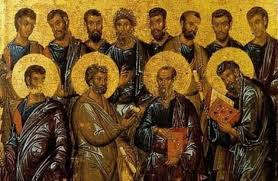
The names of the Twelve are listed in the Gospels of Matthew (10:2–4), Mark (3:16–19), and Luke (6:13–16). Peter, Andrew, James, and John were fishermen from the Sea of Galilee; Matthew (Levi) was a tax collector, scorned by his own people as a collaborator with Roman power; Simon was a Zealot, a member of the movement for the violent overthrow of Rome; Thomas, Philip, Bartholomew (Nathanael), James son of Alphaeus, Thaddaeus (Judas son of James), and Judas Iscariot are men about whose former lives Scripture is silent — but not one of them came from a priestly family, none was a scribe, none had a rabbinic education. The choice itself was a programmatic statement: God acts not through the elite but through those the world counts as nothing. "God chose the weak things of the world to shame the strong" (1 Corinthians 1:27).
For three years the disciples followed Jesus, witnessed miracles, heard the Sermon on the Mount, stood by at the Transfiguration. But the crucifixion sent them into flight. Peter denied him three times. The rest hid behind locked doors "for fear of the Jews" (John 20:19). The resurrection shook them, but the decisive moment was Pentecost: a sound like a rushing wind, tongues of fire over each of them, and all were filled with the Holy Spirit (Acts 2:1–4). Terrified men who had been hiding in an upper room walked out into the streets of Jerusalem — and three thousand people were converted that same day. Pentecost is the birth of the Church.
Before the Ascension, Christ gave the Great Commission: "Go and make disciples of all nations, baptizing them in the name of the Father and of the Son and of the Holy Spirit" (Matthew 28:19). The phrase "all nations" (πάντα τὰ ἔθνη) marked a break with Jewish exclusivity — salvation was meant for every human being on earth. The apostles took it literally: Peter and Paul reached Rome, Andrew Scythia and Achaea, Thomas India, Bartholomew Armenia, Matthew Ethiopia.
Almost all of them died violent deaths. James, son of Zebedee — the first martyr among the Twelve — was beheaded on the orders of Herod Agrippa around AD 44 (Acts 12:2). Peter was crucified in Rome upside down, at his own request, thinking himself unworthy to die as his Lord had died. Andrew was crucified on a diagonal cross at Patras. Thomas was run through with spears in India. Bartholomew, according to tradition, was flayed alive. The only one of the Twelve whom tradition allows a natural death is John the Evangelist, who lived to a great old age in Ephesus. Not one of them recanted. Men may die for a delusion they sincerely believe; they do not die for a fabrication they invented themselves.
A figure apart is Paul, the "apostle to the Gentiles," who was not among the Twelve. A Pharisee, a pupil of Gamaliel, a Roman citizen — he persecuted the Church ferociously and approved the stoning of Stephen. On the road to Damascus a light struck him blind: "Saul, Saul, why do you persecute me?" (Acts 9:4). Paul's conversion is one of the hinges of world history. It was he who formulated the key doctrines: justification by faith rather than by works of the Law (Romans 3:28); the Church as the Body of Christ (1 Corinthians 12:27); salvation as a gift of grace (Ephesians 2:8–9). His fourteen epistles make up nearly a third of the New Testament. He was beheaded in Rome under Nero.
Out of the Twelve grew a structure that exists to this day: apostolic succession, an unbroken chain of ordinations running from the apostles to the bishops. Already around AD 95, Clement of Rome was asserting that the bishops are the apostles' successors. Every bishop alive today is joined by ordination to the Twelve, and through them to Christ himself. The Church founded by twelve Galilean fishermen and a tax collector is the same Church that exists now.