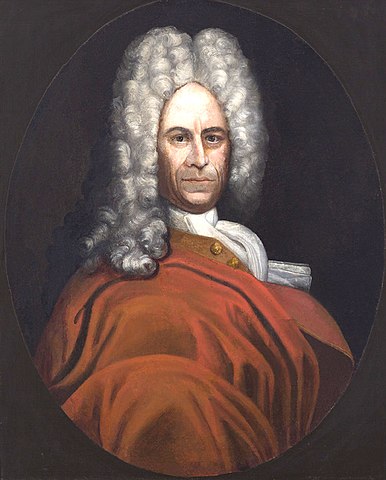
There are philosophers who are volcanoes and philosophers who are architects. The first erupt with ideas, the second raise buildings. Christian Wolff (1679–1754) was an architect to the marrow of his bones. Born in Breslau, a professor at Halle and Marburg, he seems to have discovered not a single dazzling truth — yet he did something no less important: he built the house in which German thought would live for nearly half a century, right up until the arrival of Kant. And the German philosophical language itself, with its "representations," "grounds," and "sufficient reasons," was to a great extent cut and stitched by his hands.
Wolff was the heir of Gottfried Leibniz — but an heir of a peculiar kind. Where in Leibniz thought flashed out in letters, sketches, and brilliant conjectures, scattered and left unspoken, Wolff took these sparks and built from them a rigorous system. He turned living Leibnizianism into a school metaphysics — into a textbook. And there was no debasement in this: for an idea to outlive its author, someone must give it a form by which it can be taught. Wolff became that someone.
His method was rationalist deduction. Begin with clear definitions, draw out their consequences with geometric inexorability, admit not a single contradiction — and truth will build itself up on its own, step by step. Wolff, as it has been said of him, "formalized all logical concepts to an extreme, denying contradictions in things and in thought." Herein lies both the strength and the weakness of his method: in it the world becomes transparent and orderly, but everything dark, irrational, and tragic drains away. Reason here is not a wayfarer in the mist, but a draftsman at a well-lit table.
Wolff drew up the very edifice of knowledge as well. He divided philosophy into the theoretical — ontology, cosmology, psychology, and natural theology — and the practical: ethics, natural law, politics. With particular subtlety he dissected psychology: into empirical psychology, which studies the connection of soul and body through experience, and rational psychology, which proves the immortality of the soul from concepts. And at the foundation of the whole edifice he laid God — "a self-subsistent being possessing absolute power and reason" — while he conceived of nature as His work, rationally ordered and therefore knowable.
Remarkable, too, is his faith in the vocation of philosophy. Wolff "regarded his philosophy as a means to attain the universal blessedness of mankind" — for him, clarity of thought was not an end in itself but a road to happiness. If people learn to reason rigorously, they will become wiser, kinder, freer from superstition. In this he is a true son of the Enlightenment, believing that the light of reason is able to remake life. It is no accident that he wrote his textbooks in German, and not only in learned Latin: knowledge was meant to descend from the lecterns of the schools to the people.
His influence was immense. The Wolffian school dominated the German universities for a whole generation; students learned from his books and sharpened their objections upon him. At Halle and Marburg, Mikhail Lomonosov studied under him, and through Wolff joined the great current of European science — and the St. Petersburg Academy owes much to this connection. One might say that one of the threads of learning in the East reaches back into this tidy German house.
And then came Immanuel Kant — and he knocked on this house so hard that its walls trembled. The whole of "critical philosophy" grew up as an argument against the confidence that pure reason is able to deduce God, the soul, and the world from bare concepts. But for there to be something to criticize, one first had to build — and it was precisely Wolff who built it. Herein lies his quiet greatness: he created the very system from which, pushing off against it, German thought made its great leap. Architects rarely become the heroes of legend, but without their walls the heroes would have nowhere to make their stand.