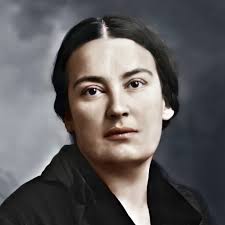
Mother Maria Skobtsova (in the world Elizaveta Yurievna Skobtsova, née Pilenko, and Kuzmina-Karavaeva by her first marriage; 1891–1945) was a nun, a Russian poet, memoirist, essayist and public figure, and an active member of the Russian Student Christian Movement. Her circle included Nikolai Gumilyov, Anna Akhmatova, Osip Mandelstam, Aleksei Tolstoy, Mikhail Lozinsky, Maximilian Voloshin and Aristarkh Lentulov.
In her youth she was drawn to poetry and literature, but also to politics and theology, and was a friend of Alexander Blok. She joined the Socialist Revolutionary party, and after the revolution served as mayor of Anapa. She was the first woman to study theology, by correspondence, at the St Petersburg Theological Academy. In 1932 she took monastic vows and gave her immense energy and rare gifts to the service of the Church. A gifted speaker, Mother Maria served for a time as travelling secretary of the Student Christian Movement and played a prominent part in the League of Orthodox Culture.
On her initiative a charitable and cultural-educational society, Orthodox Action, was founded in Paris; its members included Nikolai Berdyaev, Father Sergius Bulgakov, Georges Fedotov and Konstantin Mochulsky. The society helped many Russian émigrés left without means of support, and took part in the French Resistance during the Nazi occupation.
Mother Maria visited hospitals for the mentally ill and French prisons to help Russian prisoners, many of whom were left especially helpless by their ignorance of French. She herself lived in extreme poverty, aiding the wretched and lifting up the despairing. Under the German occupation of Paris, in February 1943, she was arrested together with her son Yuri (she had been married before taking the veil) and her faithful collaborator in Orthodox Action, Father Dimitri Klepinin (1904–1944). Accused of sheltering Jews, they were sent to the concentration camps.
Mother Maria strove not only for personal, sacrificial love but for an Orthodox understanding of social questions. She graduated from the St Sergius Orthodox Theological Institute in Paris, was a spiritual daughter of Father Sergius Bulgakov, and knew intimately such Russian thinkers as Nikolai Berdyaev, Semyon Frank, Georges Fedotov and Vasily Zenkovsky. In creative exchange with them, and in the practical work of Orthodox Action, she matured into an original thinker and theologian as well as an active servant of Christian mercy. In her view, the answer to the challenge flung at Christianity in the twentieth century lay not in accommodation to the world in the spirit of secular humanism, but in the union of love for God with love for man. In this context she advanced her idea of a "mysticism of human communion": "…destroy love for man, and you destroy man himself… and no path to the knowledge of God will remain. On the other hand, one cannot truly love man without loving God."
Mother Maria was put to death in the gas chamber of Ravensbrück on 31 March 1945, a week before the camp was liberated by the Red Army. On 6 January 2004 she was canonized by the Patriarchate of Constantinople as a monastic martyr.