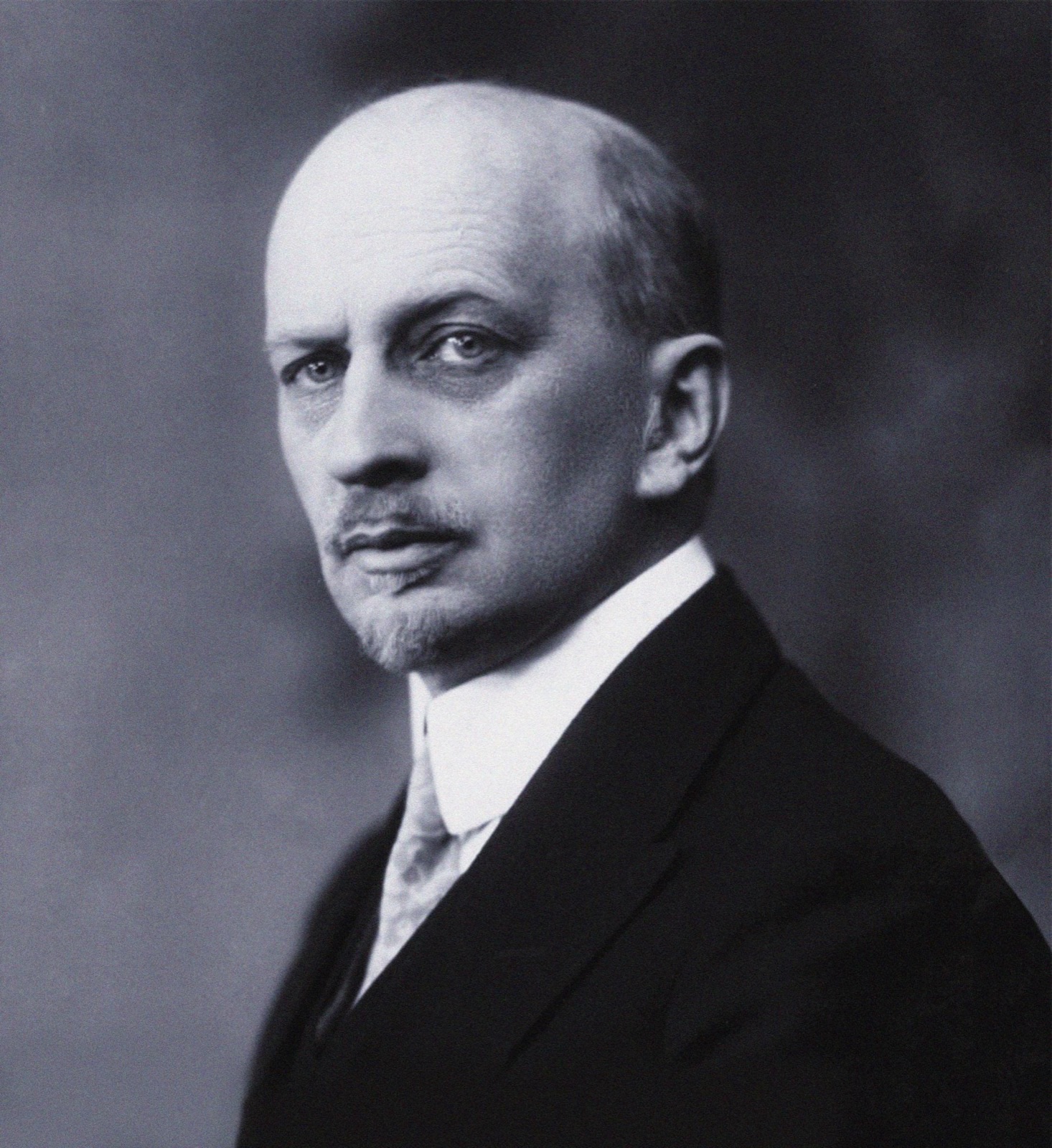
There are philosophers of the study and there are philosophers of destiny. Ivan Ilyin (1882–1954) was the second kind: for him thought always remained a "spiritual labour of the soul," the work of the whole man, not a play of the intellect. A jurist by training, a pupil of the legal scholar Pavel Novgorodtsev, he sought not abstract formulas but that self-evidence for the sake of which it is worth living — and this theme he carried through a whole life divided in two: the first half in Moscow, the second in exile.
He began with the most difficult thing of all — with Hegel. His two-volume dissertation, "The Philosophy of Hegel as a Doctrine of the Concreteness of God and Man" (1918), is still regarded as one of the summits of Russian scholarship on German idealism. Ilyin did not paraphrase Hegel but argued with him: he saw an inner crisis in the Hegelian system — the inability of the rational concept to subject to itself completely the dark, irrational element of the living world. From this dispute he drew his own conviction: philosophy begins not with concepts but with experience, with the immediate living-through of its object, to which intuition and rigorous analysis come only afterward.
Thus was born his doctrine of self-evidence. Self-evidence, for Ilyin, is not the "clarity" of a textbook proof but a special creative capacity to be so seized by truth that in it "the whole soul of the investigator dissolves." Its chief property is objectivity: thought must cleave to its very object, live its way into it, give itself over to it wholly. The philosopher, he held, is bound to preserve "a special purity and sensitivity of the theoretical conscience" — because without honesty before its object, all knowledge degenerates into an empty play of words.
His most resounding book was On Resistance to Evil by Force (1925). In it he entered into direct dispute with the Tolstoyan non-resistance to evil. Ilyin did not glorify force — he agonizingly investigated its limits. Good he defined as "spiritualized love," the free and conscious orientation of the human being toward God, and evil as "anti-spiritual enmity," a turning away from the Divine. And yet, he argued, there are situations in which a loving person is left with no other means of stopping evil than force or the sword — and then to use them is not a sin but a heavy moral duty, taken up with the full measure of responsibility and guilt. "Without freedom," he wrote, "there is no way to a life worthy of the human being, to the spirit and to God."
In law he sought not a code of prohibitions but legal consciousness — a living spiritual force within the human being himself. Law he assigned to the "spiritual sphere": a just law must correspond to the nature of the human being as a spiritual creature. Hence his three "axioms of legal consciousness": the law of spiritual dignity, the law of autonomy — the citizen as an "inwardly free, responsible centre of will" — and the law of the mutual recognition of people by one another. At the foundation of the whole edifice of law, according to Ilyin, lies one inalienable right — to human dignity; and the task of law is to reconcile the natural inequality of people with their spiritual equality.
He had a rare gift as well — a philosophy of art: in his book "The Foundations of Art. On the Perfect in Art" he wrote of beauty as the appearance of spiritual meaning through sensuous form, demanding of the artist the same objective honesty as of the philosopher. His life took a harsh shape: after the revolution he was expelled from the country in 1922, wandered through Europe, lost his chairs, but went on writing in Russian, believing that one day he would be read in his homeland. A kindred spirit of Vladimir Solovyov and an interlocutor of Alexei Losev within the circle of the Religious-Philosophical Society, Ilyin remains one of the most integral voices of Russian religious metaphysics — a thinker for whom philosophy was not knowledge about life but a way of living it with dignity.