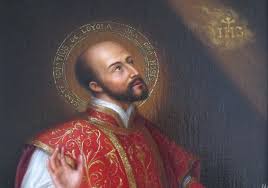
He was born around 1491 at the castle of Loyola, in the Basque mountains of northern Spain, the youngest of thirteen children in a noble family, and was given the baptismal name Íñigo. From his youth he dreamed not of prayers but of military glory and courtly triumphs: he served as a page, then as an officer, devoured tales of chivalry, and had a reputation for vanity and a hot temper.
His military career ended in a single day. In 1521, during the defense of the fortress of Pamplona against the French, a cannonball shattered his right leg and grazed the left. The surgeons broke and reset the bone several times, so that the leg would not be left crooked and a limp would not betray the former dandy. Confined to bed in his ancestral castle, he asked for chivalric romances — but the only books at hand were a life of Jesus Christ and lives of the saints. Out of boredom he read them for months, and gradually his fantasies of feats of arms began to give way to other dreams — of a feat of the spirit.
Barely back on his feet, he left the castle as a pilgrim. On his way, at the Benedictine monastery of Montserrat, he laid down his sword and dagger before a statue of the Mother of God and gave his nobleman's clothes to a beggar. He then spent almost a year in the town of Manresa, where he lived on alms and prayed at length in a cave on the outskirts. There, amid fits of despair and spiritual illuminations, he underwent the inner upheaval that would form the basis of his chief book — the "Spiritual Exercises," a practical guide for those who wish to understand their own soul through meditation, prayer, and the examination of conscience.
From Manresa he set out for Jerusalem — to venerate the places where Christ had lived and died, and to remain there as a missionary. But he was not allowed to prolong his pilgrimage: the Franciscans responsible for the Christians in the Holy Land sent him back to Europe. It was then, already a grown man past thirty, that the former officer sat down at a school desk beside young boys — to learn the Latin without which there was no road into any university.
Eleven years went into his studies at Alcalá, Salamanca, and finally Paris, where he took his master's degree and Latinized his name to Ignatius. In Paris a group of like-minded companions gathered around him — among them Francis Xavier and Pierre Favre — whom he led through the same "Spiritual Exercises" that he had suffered through himself in the cave at Manresa. On August 15, 1534, seven friends took vows of poverty, chastity, and missionary service in a church on Montmartre — and it is from that day that the history of the future order is customarily reckoned.
In 1540 Pope Paul III confirmed the new monastic body by a bull — the Society of Jesus, soon to be called the Jesuit order. Ignatius, who not long before had dreamed of martial valor, became its first general and governed the order from Rome to the end of his life, founding schools and colleges, sending missionaries to India, Japan, and Brazil, and turning the personal spiritual experience of a wounded soldier into a system of education and service that operates across the whole world.
He died in Rome on July 31, 1556, no longer young and gravely ill, but having lived to see the few dozen colleges he had founded grow into a network spanning Europe and the colonies overseas. In 1622 Ignatius was numbered among the saints — together with Francis Xavier, that same Paris student whom he had once led, through his own "Exercises," to the same upheaval that had befallen him on the sickbed at Loyola.