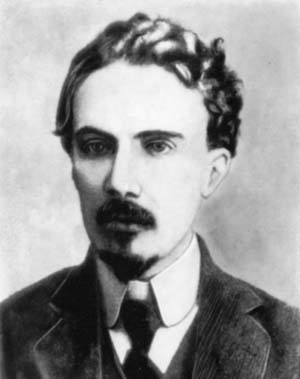
As a young man he belonged to the social-democratic movement and believed in the laws of history. As a mature man he would write that history is not a movement along the rails of progress at all, but a "tragic mystery", at the center of which stands the free human being. This turn defined everything in the fate of Georgy Petrovich Fedotov (1886–1951) — a historian of the Middle Ages who became one of the most perceptive religious thinkers of the Russian emigration, and the first to make a serious attempt to understand what animated the holiness of Old Russia.
His path is typical of his generation, and for that reason expressive. Saratov, St. Petersburg University, the study of medieval history under I. M. Grevs, an academic post, a professorship. From 1925, life abroad; for many years he taught at the Orthodox Theological Institute in Paris, and toward the end of his life at St. Vladimir's Seminary in New York, where his elder companion in emigration, Vladimir Lossky, also lived out his years. A medievalist by training, Fedotov turned the whole of his historical lens on a single question: how holiness is born and lives within a people.
His principal books are The Saints of Ancient Russia (1931) and Spiritual Verses (1935). Here Fedotov made a move unusual for a historian: he began to read the lives of the saints and the folk spiritual poems not as naive legends but as testimonies of a whole people's living religious experience. Out of this reading there emerged a distinctive image of Russian holiness — not the stern, law-bound ascetic, but a "kenotic" type: a saint who follows the humbled, self-emptying Christ, meek, merciful, ready to share the fate of the wronged. In this way Fedotov traced out what he called the "profound distinctiveness" of the Russian spiritual tradition.
Out of church history there also grew for him a philosophy of culture. Fedotov firmly rejected historical determinism — the belief that the future is predetermined by impersonal forces. History rests on human freedom, and is therefore always dramatic and open. Hence his persistent thought about the "abiding significance of cultural creation": the eschatological expectation of a Kingdom not of this world in no way cancels the value of what a person creates here and now. The Christian has no right to despise culture — it too is an answer to the calling to create.
Fedotov defended this position as a publicist as well. Together with like-minded colleagues he founded the journal New City (Novy Grad) in Paris, where he defended Christian humanism against "mechanical progress, indifferent to the human being and to human creation." His recurring theme was the relation between the paths of Russia and the West — not as hostile poles but as "distinctive yet interconnected" principles. In the Russian consciousness he distinguished both the heavy type of the "Muscovite servant of the state" and, opposed to it, a "maximalist" type of rootless spirituality straining toward heaven — and he saw the drama of Russia in the unceasing contention between these two principles.
Fedotov's significance lies in this: he restored to holiness a historical dimension, and to history a dimension of holiness. Where some saw only dry chronology and others a pious legend, he discerned faces — actual people making a free choice before eternity. His "kenotic" portrait of the Russian saint remains to this day a key to the nation's religious memory. And his anxiety over the fate of culture in the face of "mechanical progress" sounds, perhaps, even sharper today than it did in the cramped Parisian halls where he and his interlocutors — from Nikolai Berdyaev to the whole circle of the Russian religious renaissance — debated the meaning of history.