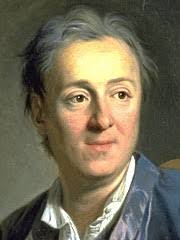
The son of a cutler from Langres, schooled by the Jesuits, in his youth scraping by on translations and lessons on the edge of poverty — such was the man who one day undertook to contain all the knowledge of humanity in a single compendium. Denis Diderot (1713–1784) did not merely take part in his century — he was its seething heart. And the chief monument to that seething life is the Encyclopedia, or Systematic Dictionary of the Sciences, Arts and Crafts, over which he laboured for nearly thirty years.
The Encyclopedia was conceived as a technical reference work — and Diderot turned it into a battering ram against the old order. As editor-in-chief he wrote some 1,200 articles and gathered under one cover the finest minds of France, among them Voltaire and Montesquieu. In the most innocent-looking notes he hid gunpowder: in the article "Scepticism" he calmly let drop that "doubt is a sure step toward truth," setting living thought against dead dogmatism. The censors raged, the printers took fright and secretly struck out the bold passages — and yet the dictionary still spread across Europe, carrying ideas that made the old world crack at the seams.
Diderot himself travelled a swift road — from the deism of his Philosophical Thoughts to the atheism and materialism of the Letter on the Blind. His materialism was of a particular, living cast. If many of the heirs of John Locke conceived of matter as inert, Diderot insisted: "Matter is the only substance, and the cause of its existence lies within itself." Matter is not dead; it moves of itself, it ferments and foams of itself. Instead of identical atoms he conceived of qualitatively distinct molecules, each with its own inner force — and in his hands the universe breathed like a living body.
Hence his most daring conjecture: "sensibility is a universal property of matter." The capacity to feel slumbers even in a stone; in the living it awakens, and out of sense perceptions, without any "incorporeal soul," consciousness grows. Mind, for Diderot, is not a guest sent into the body from outside but a flower that has bloomed on the stem of nature itself. He went further still: the human being, like every species, "has its own history of formation" — and historians of evolutionary theory rightly number him among their forerunners, long before Darwin.
But Diderot was not only a thinker — he was an artist of thought, and his favourite form was the dialogue, in which truth is not proclaimed but struck out from collision. His Rameau's Nephew is a conversation between a philosopher and a brilliant, shameless parasite who argues that nature itself gave birth to his vices. Hegel saw in this work a living dialectic, a picture of the divided consciousness of the age. And The Paradox of the Actor laid bare a burning contradiction of the stage: the actor loses himself in a role all the more powerfully the colder and the more fully he remains himself. Diderot loved paradox not for effect but because he sensed that the truth of life is always two-sided.
In aesthetics he proclaimed: "There is nothing incorrect in nature," — and demanded of painting and drama truth instead of a cold imitation of ancient models. He championed the "serious genre" — the drama about people of the middle estate, about their tears and their duty, against the classicist stage on which only kings and heroes were permitted. Art, for him, was meant to move and to educate, to turn the spectator to face real life.
What, then, is the significance of this tireless man who drew up projects of universal, free education for distant Russia? It is that he joined the unjoinable: the passion of the systematizer and the liveliness of the artist, matter and feeling, the dictionary and the novel. Beside the cold clarity of Voltaire his thought seems warm and flowing, like the very nature he so loved. And today, opening any encyclopedia, we — without knowing it — leaf through the distant echo of his vast design: to contain the world in a book, in order to set the human being free.