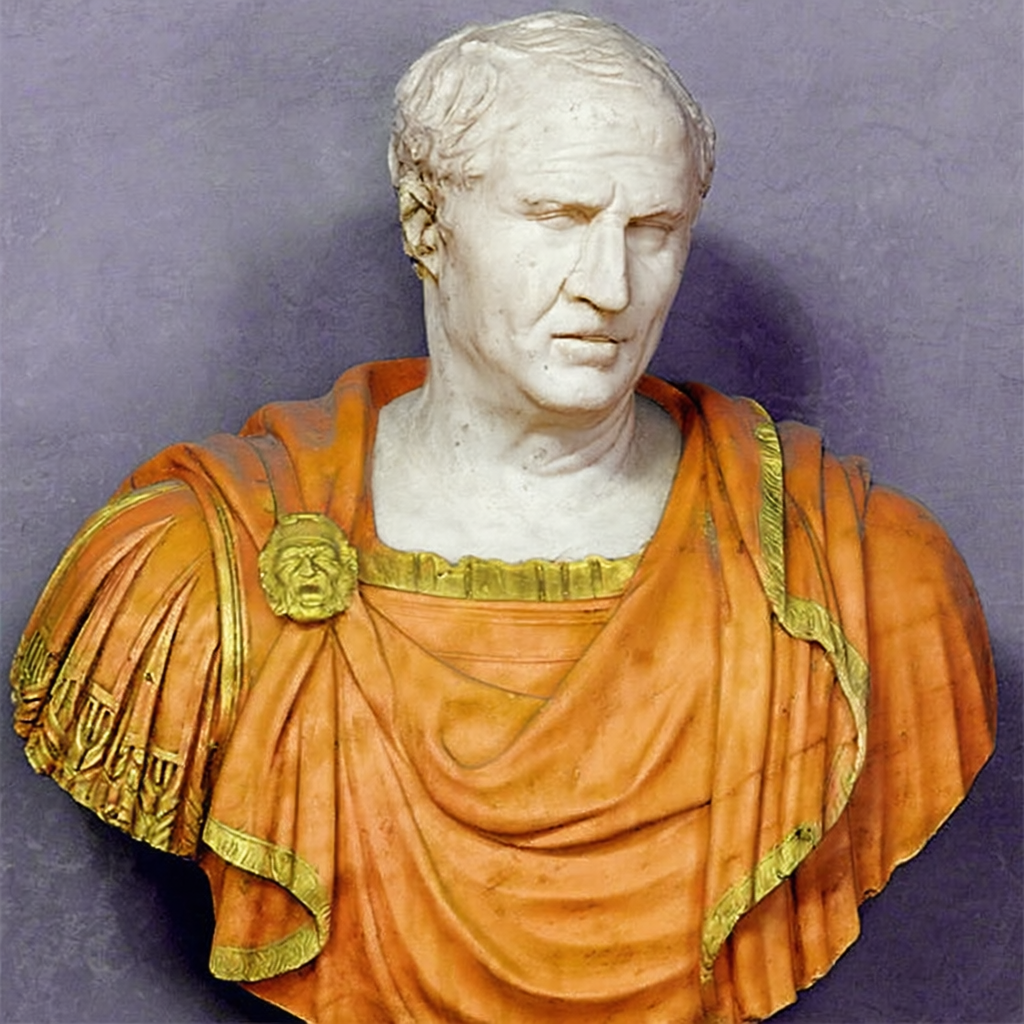
Imagine a man who holds another's wealth in his hands — and understands that the heirs will squander it unless the treasure is rendered into a language they can grasp. Such an heir was the Latin tongue, and the treasure was Greek thought, amassed over four centuries. Marcus Tullius Cicero (106–43 BC) accomplished what before him had seemed impossible: he made the stern language of jurists and generals speak of the soul, of the good, of the nature of the gods. He did not merely translate — he forged the very words that did not yet exist in Latin, and thereby gave the West the instrument with which it would go on thinking for two thousand years.
Cicero founded no school and took no pride in that. He passed through the tutelage of all at once — he listened to Epicureans, Stoics, Peripatetics, Academics — and carried away the conviction that truth is patented by none of them. His eclecticism was not laziness of mind but a considered stance: to take from each whatever withstands the test of reason and the experience of civic life. In this sense he did on Roman soil what the school-pride of the Greeks had prevented them from doing — he assembled from scattered teachings a single human image, in which there is room both for sober doubt and for firm duty.
In his heart he belonged to the New Academy — heir to the school of Plato, which had turned from dogma toward doubt. Here Cicero felt at home: he shunned unconditional verdicts about the final truth and held that what is accessible to man is not absolute knowledge but only the probable — that which convinces, withstands argument, and leads to action. This was a skepticism not destructive, as with certain Greeks, but working: it did not paralyze the will but cleansed it of superstition and self-assurance, leaving room for free choice.
But in questions of conduct, doubt had to fall silent — for otherwise how is one to live? And here Cicero leaned on the Stoics, on the disciples of Zeno of Citium, for whom virtue — wisdom, justice, courage, temperance — was the sole genuine source of happiness. Yet he softened Stoic severity with the Peripatetic sense of measure: external goods — health, sufficiency, friends — are not evil; they are to be desired, so long as they do not enslave. And in the sensual promises of Epicurus he never did place his trust, holding that man is made not for pleasure but for work. So in the treatise "On Duties" there was born one of the first teachings in Latin about moral duty — about what we owe to other people simply because they are people.
In the gods he sought not the idols of the crowd but the rational order of the universe. In the work "On the Nature of the Gods" Cicero weighs the opinions of the schools, rejects crude superstition and fatalism, and defends freedom of the will against blind fate. In politics he dreamed of a mixed government, in which would be joined the merits of the people, of the best, and of a single head — and he saw a prefiguration of this in the Republic he served until his death. His conviction in natural law — that above the written laws stands an unwritten law, one and the same for all peoples and all times — became one of the most enduring ideas of European thought.
Cicero fell victim to civil strife, not living to reach the old age of which he wrote so luminously. But his word proved stronger than the sword. The Fathers of the Church learned clarity from him, the humanists of the Renaissance read him as one of their own, the Enlightenment drew from him its concepts of duty, right, and civic dignity. He discovered no new system — he did something greater: he showed that philosophy is not a tower for the hermit but a school of life for the citizen. And every time a man asks himself what he owes his neighbor and his country, he is, without knowing it, continuing the conversation that Cicero began.