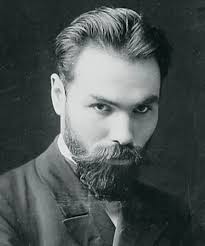
Valery Bryusov was born in 1873 in Moscow, into a merchant family far removed from literature. In his school years he discovered the French Symbolists — Verlaine, Mallarmé, Rimbaud — and decided that this was precisely what Russian poetry lacked: a self-legislating art for art's sake, a music of words, a dark meaning. Having graduated from the Faculty of History and Philology at Moscow University, from his very first student years he acted as a builder: not merely writing verse, but engineering a movement.
In 1894–1895 he published three small collections titled "Russian Symbolists," most of them written by himself under various pseudonyms. The one-line poem "Oh, cover your pale legs" was a calculated provocation rather than a spontaneous one. Bryusov wanted scandal, because scandal is conversation. A few years later, with his involvement, the publishing house Scorpion and the journal The Scales (1904–1909) arose — the chief tribune of Symbolism — along with an entire infrastructure for the new poetic language.
His own verse was something else. The collections "Urbi et Orbi" (1903) and "Stephanos" (1906) revealed a poet of iron rhythm, with images drawn from antiquity and the Renaissance, with Gothic precision of detail. Bryusov loved historical costume — Assyria, Rome, the Middle Ages — but not for the sake of exoticism: through them he spoke of will and passion, of obsession and power. The poem "The Coming Huns" (1905) predicted barbarians who would sweep away the old world — with grim exultation rather than horror.
His major work of prose is the novel "The Fiery Angel" (1907). At its center is the story of the German mystic Ruprecht, in love with a woman possessed by a demon. The novel is documented with academic thoroughness: Bryusov studied sixteenth-century occult treatises and wove real historical figures into the text — Agrippa of Nettesheim and Doctor Faustus. "The Fiery Angel" became the source for Prokofiev's opera (written 1919–1927, first staged in 1954). The novel has been translated into many languages and remains one of the few cases in which Russian Symbolism succeeded in a major prose form.
Bryusov was a strict technologist of verse. He taught young poets that inspiration is not a method but a result of labor. "To a Young Poet" (1896) is a three-stanza testament-poem: worship art, do not live in the present, love only yourself. Today these lines read as a manifesto of egocentrism; at the time they were the antithesis of didactic civic poetry. His circle shaped poets who would later push away from him: Blok, Akhmatova, Mandelstam, Tsvetaeva — all passed through the field he had created.
After the Revolution of 1917, Bryusov joined the Bolshevik party — an act his colleagues never forgave. He took up Soviet cultural construction: he headed the Literary and Artistic Department of the People's Commissariat of Enlightenment, then the Higher Institute of Literature and Art. Whether this was a choice of conviction or a calculated bid for survival remains disputed to this day. He died in 1924 of pneumonia — shortly before the struggle began over the literary inheritance the Symbolists had left to Soviet poetry.
Bryusov stands at the beginning of a chain that gave rise to the entire Silver Age of Russian literature. He himself proclaimed the principle of constructing a literary field — and built it. His answer to the question of the nature of evil was aesthetic: dark images have form, and therefore truth. That truth did not frighten him.