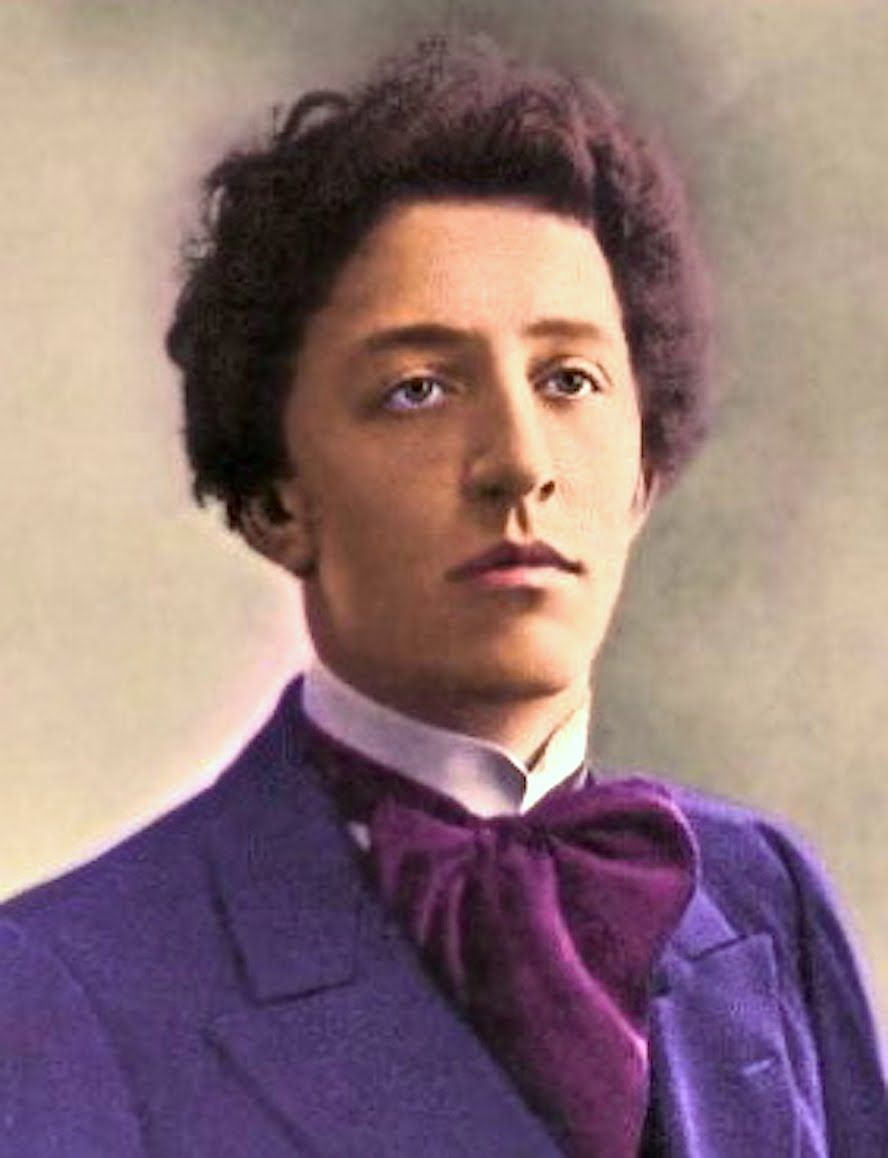
Alexander Blok was born on 16 November 1880 (28 November, New Style) in St. Petersburg. His mother was the daughter of Andrei Beketov, rector of St. Petersburg University. Soon after Alexander's birth she left her husband, the Warsaw jurist Alexander Lvovich Blok (1852–1909), and in 1889 married again — a Guards officer, F. F. Kublitsky-Piottukh — while her son kept his father's surname. At nine, Blok settled with his mother and stepfather in the Grenadier Barracks on the outskirts of Petersburg, on the bank of the Bolshaya Nevka; that same year he entered the Vvedenskaya Gymnasium.
In 1897, abroad with his mother at the German spa town of Bad Nauheim, Blok fell into his first intense youthful love, with Ksenia Sadovskaya — an attachment that left a deep mark on his work. That same year, at a funeral in Petersburg, he met Vladimir Solovyov. In 1898 he finished the gymnasium and entered the law faculty of St. Petersburg University; three years later he transferred to the Slavic-Russian division of the faculty of history and philology, from which he graduated in 1906. At the university he came to know Sergei Gorodetsky and Alexei Remizov, and his second cousin Sergei Mikhailovich Solovyov (the younger), later a priest, became one of the young Blok's closest friends.
He had written his first verses at five. At ten he produced two issues of a magazine called The Ship, and from 1894 to 1897 he and his brothers put out a handwritten journal, The Herald. Every summer of his childhood was spent at Shakhmatovo, his grandfather's estate near Moscow; eight kilometers away lay Boblovo, the estate of Beketov's friend, the great Russian chemist Dmitri Mendeleev. At sixteen Blok fell in love with the theater and joined a dramatic circle in Petersburg, though after a first success he was offered no further roles.
In 1903 Blok married Lyubov Mendeleeva, Mendeleev's daughter and the heroine of his first book of poems, Verses on the Beautiful Lady. His feelings for his wife were strong, but he periodically kept up liaisons with other women — for a time the actress Natalya Nikolaevna Volokhova, later the opera singer Andreyeva-Delmas — and Lyubov Dmitrievna allowed herself infatuations of her own. Out of this grew Blok's conflict with Andrei Bely, described in the play The Puppet Show: Bely, who saw in Mendeleeva the incarnation of the Beautiful Lady, was passionately in love with her, but she did not return his feeling. After the First World War, though, the marriage mended, and in his last years the poet was a faithful husband to Lyubov Dmitrievna.
The year 1909 brought two blows to the family: the death of Lyubov Dmitrievna's child and the death of Blok's father. To recover, the couple went to Italy. His Italian poems won him admission to a society called the Academy, whose members, besides Blok, included Valery Bryusov, Mikhail Kuzmin, Vyacheslav Ivanov, and Innokenty Annensky. In the summer of 1911 he went abroad again, this time to France. In 1912 he wrote the drama The Rose and the Cross; Stanislavski and Nemirovich-Danchenko liked the play, but it was never staged.
On 7 July 1916 Blok was called up to serve in an engineering unit of the All-Russian Zemstvo Union, and he served in Belarus. By his own admission, in a letter to his mother, his chief wartime interests were "food and horses." In early May 1917 he was taken on as an editor for the Extraordinary Commission of Inquiry into the unlawful official acts of former ministers, chief administrators, and other senior officials of the civil, military, and naval departments. In August he began work on a manuscript he regarded as part of the Commission's future report; it appeared in the journal Byloe (No. 15, 1919) and as a small book, The Last Days of Imperial Power (Petrograd, 1921).
Early in 1920 Frants Feliksovich Kublitsky-Piottukh died of pneumonia, and Blok took his mother in to live with him — though she and his wife did not get along. In January 1921, on the eighty-fourth anniversary of Pushkin's death, Blok delivered his famous address "On the Calling of the Poet" at the House of Writers. That spring he and Fyodor Sologub applied for exit visas; the question went to the Politburo of the Central Committee, and permission was refused. Lunacharsky observed: "Quite literally, by not letting the poet go, and at the same time denying him the tolerable conditions he needed, we tortured him to death." A number of historians have held that Lenin and Menzhinsky played an especially baleful part in the poet's fate by forbidding him — ill with scurvy, asthma, and a severe nervous disorder — to travel to a sanatorium in Finland for treatment, a question raised, at the petition of Maxim Gorky and Lunacharsky, at the Politburo session of 12 July 1921. The exit permission that Kamenev finally secured on 23 July came too late to save him.
In desperate material straits and gravely ill, Blok died on 7 August 1921, in his last Petrograd apartment, of an inflammation of the heart valves. A few days earlier a rumor had run through Petersburg that the poet had gone mad; indeed, on the eve of his death he was long delirious, gripped by a single thought — whether every copy of The Twelve had been destroyed. Yet he died in full possession of his mind, which gives the lie to the rumor. At the end, after the refusal of 12 July of his request to go abroad for treatment, he deliberately destroyed his notes and refused food and medicine.
He was buried at the Smolensk Cemetery, where the Beketov and Kachalov families also lie, among them his grandmother Ariadna Alexandrovna, with whom he had corresponded. The funeral service was held in the Church of the Resurrection of Christ. His remains were later reinterred at the Volkovo Cemetery.