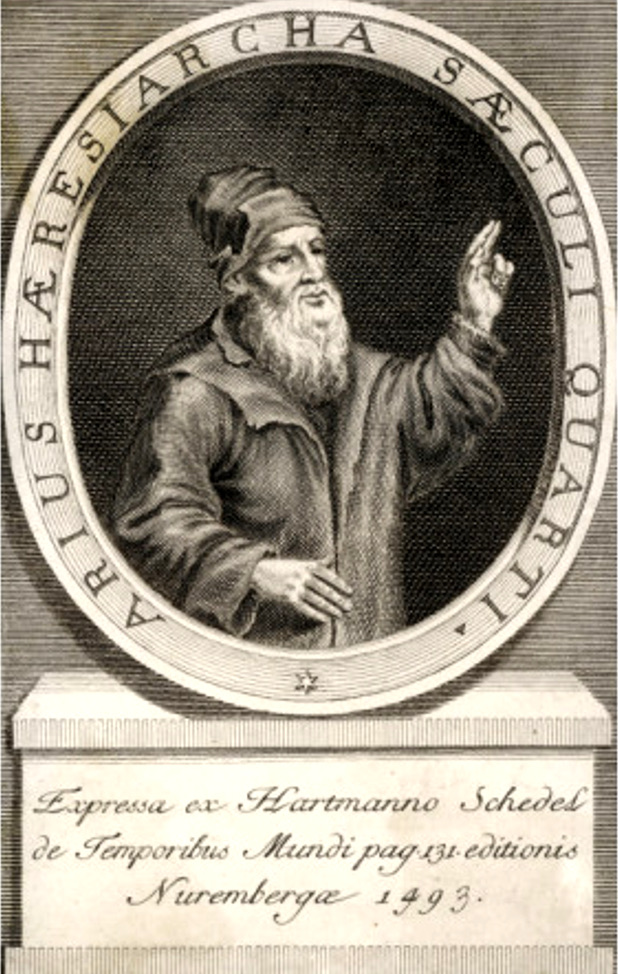
Arius was born around 256, probably in Libya, and became a presbyter in Alexandria — a city where theology was as much a topic of everyday street conversation as the price of bread was elsewhere. He was no rebel and sought no scandal. He sought clarity. And he asked a question that would leave the Christian East reeling for the next fifty years: if the Son is begotten of the Father, then this begetting has a beginning — which means "there was [a time] when he was not."
Arius's logic was persuasive in its simplicity. God the Father is one; he is without beginning and proceeds from no one — and this is precisely what it means to be God in the proper sense. The Son, however, proceeds from the Father, and therefore the Son cannot be equal to him, nor can he be eternal in the same way the Father is. The Son is the highest of creatures, the first and most perfect, through whom everything else was made — but still a creature, not the Creator himself. He is not of one essence with the Father; between them lies the gulf that separates Creator from created. This teaching — Arianism — spread rapidly across the East: it was intelligible, strictly monotheistic, free of the mind-bending paradox of "God begotten of God."
It was precisely this clarity that alarmed Arius's opponents most. If the Son is a creature, however exalted, then what happens in the Incarnation? Then what comes to humanity is not God himself, but an intermediary, a demigod, some great being suspended between heaven and earth. And this endangers not a fine point of wording, but salvation itself. The Christian hope was that in Jesus Christ, what joined itself to humanity was not a substitute for God but God as such — that human nature was taken up into the divine life and thereby healed. But if what became incarnate was a creature, then creature saves creature, and the abyss between God and man remains uncrossed.
Thus was born the famous formula. At the Council of Nicaea in 325, the Church answered Arius with a single Greek word — homoousios, "of one substance." The Son is not merely like the Father, nor close to him in dignity — he is of the very same substance as the Father; he is God from God, begotten, not made. The word was chosen deliberately, hard-edged, allowing no shades of meaning: between "of similar substance" and "of one substance" lay a single letter, but on that one letter hung the answer to the question of whom Christians meet in Christ.
Athanasius of Alexandria held that line more firmly than anyone; for him the dispute was not about abstract matters but about whether or not humanity was saved. Later thinkers, among them Gregory the Theologian, would refine and complete Nicaea's thought — but it was Athanasius who, through decades of exile and disgrace, kept the formula from dissolving into convenient compromise.
Arius's own fate proved as uneven as that of his teaching. He was condemned and exiled, then rehabilitated, then condemned again. He died in 336 — according to tradition, suddenly, on the very eve of his solemn readmission to church communion. But Arianism outlived its founder. The Germanic tribes — the Visigoths, the Ostrogoths, the Vandals — adopted Christianity precisely in its Arian form, and for several centuries Europe found itself divided between the Orthodox and the Arians. A dispute over a single word determined the history of an entire millennium.
Herein lies the strange greatness of Arius's role: the Church condemned him as a heresiarch, but in answering him it articulated clearly, for the first time, what before him had been held more in prayer than in definition. Denial forced faith to find its words. To say that in Christ God himself had come to humanity, theology had to forge the precise term "of one substance" — and with that answer the Incarnation ceased to be a beautiful image and became an assertion one could argue for, stand by, and answer for.