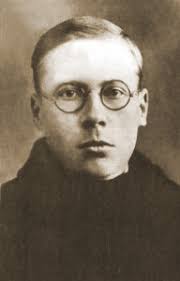
Nikolai Alekseyevich Zabolotsky (Zabolotsky also spelled Zabolotskii; 24 April [7 May] 1903, Kizicheskaya settlement, Kaimary district of Kazan uyezd, Kazan governorate – 14 October 1958, Moscow) was a Russian Soviet poet, born into the family of an agronomist. His childhood passed in the village of Sernur in Vyatka province, not far from the town of Urzhum; after finishing the real school in Urzhum in 1920 he left for Moscow to continue his education.
He enrolled at Moscow University in two faculties at once — philology and medicine. The literary and theatrical life of Moscow seized him: the performances of Mayakovsky and Yesenin, the Futurists, the Imaginists. He had begun writing poems while still at school; now he took to imitating Blok one moment and Yesenin the next.
In 1921 he moved to Leningrad and entered the Herzen Pedagogical Institute, joining the work of a literary circle, though he had, as yet, “not found his own voice.” He finished the institute in 1925.
In these years he drew close to a group of young poets who called themselves Oberiuty — the “Association of Real Art.” They were seldom published, and little; but they read their poems in public often, and membership in the group helped the poet find his path. In 1926–27 he served in the army; on his discharge he received a post in the children's book department of OGIZ, worked actively in children's literature and in the children's magazines Yozh and Chizh, and brought out children's books in verse and prose — Snake's Milk, Rubber Heads and others. In 1929 appeared the collection Stolbtsy (Columns); in 1937, The Second Book.
In 1938 he was unlawfully repressed and sentenced to five years in the camps; from 1944 to 1946 he served out a term of exile, working as a construction laborer in the Far East, the Altai region and Karaganda. In 1946 he returned to Moscow. To the 1930s and 1940s belong “Metamorphoses,” “Forest Lake,” “Morning,” “I do not seek harmony in nature” and others.
His last decade he gave largely to translating the Georgian poets, classic and contemporary, and visited Georgia. In the 1950s such poems as “The Plain Girl,” “The Old Actress” and “The Opposition of Mars” made his name known to the broad reader. His final two years were spent at Tarusa on the Oka. He was gravely ill and suffered a heart attack; there he wrote many of his lyric poems and the narrative poem “Rubruck in Mongolia.” In 1957 he visited Italy.
On 14 October 1958 Zabolotsky died of a second heart attack.