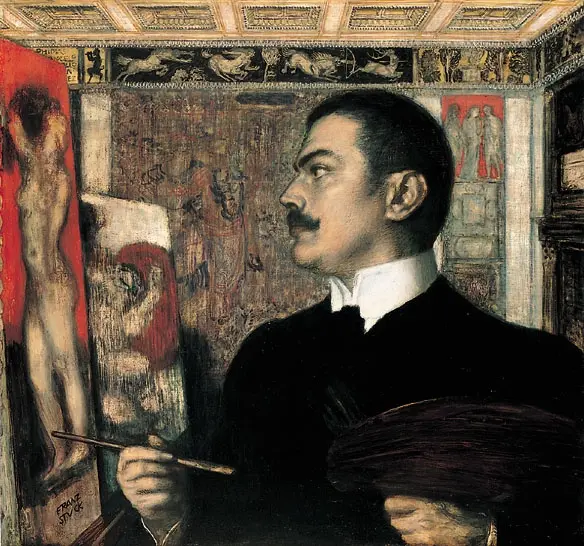
Franz von Stuck was born in 1863 in the Bavarian village of Tettenweis, into the family of a miller. His origins gave no promise of an artistic career, but his gift for drawing was noticed early, and the young man was sent to study in Munich — first at the School of Applied Arts, then at the Munich Academy of Fine Arts, from which he graduated in 1885.
His rise proved rapid for a man without connections or capital. In 1892 Stuck became one of the founders of the Munich Secession — an association of artists who rebelled against the conservative academic establishment led by Franz von Lenbach. And in 1905–1906 the Bavarian prince regent Luitpold raised him to hereditary nobility: the miller's son came to be styled Franz Ritter von Stuck.
Fame came to him with the painting The Sin (1893) — a nude Eve entwined by a huge serpent, staring straight at the viewer. The work caused a sensation at the Secession exhibition and proved so sought after that over the years Stuck painted about a dozen variants of it.
In his paintings, classical mythological subjects — fauns, sphinxes, Salome — were combined with overt eroticism and a dark Symbolist atmosphere. For this characteristic blend of academic training and disquieting sensuality his contemporaries dubbed him "Malerfürst" — "prince of painters."
Stuck rarely confined himself to the canvas alone: for many of his pictures he designed with his own hand massive, almost architectural frames — with columns, niches, and gilded ornament — so that the frame became part of the conception rather than an incidental border. The same principle of a work integral and considered down to the last detail he later carried over into the architecture of his own house. Besides painting, Stuck also worked as a sculptor, casting in bronze figures on the same mythological subjects as in his pictures — further evidence that for him the different arts were parts of a single conception, not separate professions.
He secured his standing architecturally as well: from 1897 Stuck built his own villa in Munich, designing not only the facade but the interior, furniture, and decor down to the last detail. Furniture of his own design won a gold medal at the World's Fair in Paris in 1900; today the villa operates as a museum.
From 1895 Stuck taught at the Munich Academy — and it was through his class that there passed artists destined to define the look of the next century's art: Wassily Kandinsky, Paul Klee, Josef Albers. Hardly any of them carried on his manner directly — Kandinsky and Klee took painting in a direction diametrically opposed to their teacher's academic Symbolism — but the rigorous training in draftsmanship they received from the "prince of painters" stayed with them forever.
Stuck died in 1928 in Munich — a revered academician, a nobleman, the author of one of the most recognizable paintings of Symbolism. By the end of his life the fashion for Symbolism and mythological allegory was already giving way to a very different, sharper art of the twentieth century — yet the road from miller's son to mentor of the pioneers of abstraction still fit within a single human life.