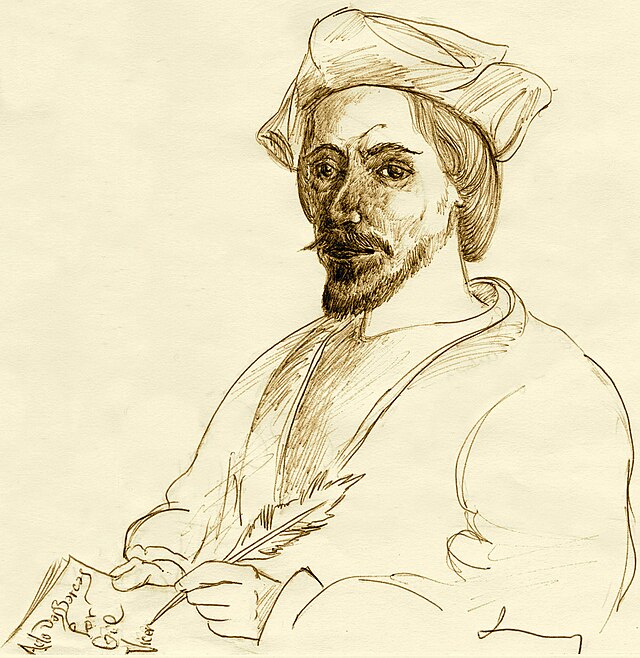
On 7 June 1502, at the court of King Manuel I in Lisbon, an heir was born — the future João III. That same night a certain craftsman entered the chambers of Queen Maria of Aragon and performed before her a brief, improvised scene in the spirit of the Christmas shepherd plays: a shepherd speaks, sings, offers his congratulations. The scene was called Monólogo do Vaqueiro — "The Herdsman's Monologue." Gil Vicente devised it himself, without leaning on any existing Portuguese theatrical tradition — because no such tradition existed. He created it.
For the next thirty-odd years he would give performances at court — first for Manuel I, then for João III. In that time more than forty plays in various genres would appear: farces, courtly allegories, religious autos, pastorals, tragicomedies. Most were written for an occasion — a feast, a victory, the birth of a prince. But behind every occasion stands one and the same question: how does a person behave when he has a choice between good and evil — and when no one in particular is watching.
His chief creation is the "Trilogy of the Boats" (Trilogia das Barcas): "The Boat of Hell" (1516), "The Boat of Purgatory" (1518), "The Boat of Paradise" (1519). The scheme is the same for all three: the recently dead souls come to the bank of a river where two boats are moored — one belonging to the devil, the other to an angel. The devil takes those who lived without conscience; the angel, those who lived with it. The play's task is to show which of Vicente's contemporaries ends up where. A knight who lived by plunder goes to hell. A sailor who died on a voyage for Portugal goes to paradise. The nobility, the clergy, the lawyers, the merchants are sorted out one by one, without mercy.
Vicente criticised the clergy with surgical precision: venal monks, vainglorious priests, religious hypocrites appear in his plays again and again. But he never attacked doctrine or the sacraments of the Church — only those who betrayed them by their conduct. This places him beside Erasmus of Rotterdam, who was being read in the same period: both wrote satire from within the system, without demolishing its foundations. The Inquisition kept watch over Vicente. It never once touched him.
He wrote in two languages — Portuguese and Spanish — sometimes mixing them within a single play according to the character. This was not eclecticism: the Iberian Peninsula of the early sixteenth century was a space where languages coexisted naturally, and Vicente's bilingualism reflected the reality of his audience. Spanish aristocrats at the Portuguese court, Portuguese merchants in Spanish ports — his theatre spoke to them all. After his death his son Luís Vicente gathered and published the surviving plays in the "Compilation" (Compilação) of 1562. Without that work most of the texts would have been lost.
Vicente himself died around 1536 — the exact date is unknown, as is the date of his birth. He left no treatises on the theatre, founded no school, formulated no theory. His theory is his plays. And their central question, which he posed for thirty years running, is one and the same: why does a free man, understanding that he is doing evil, still choose it? The devil's boat in the "Trilogy of the Boats" is never left empty. This is neither pessimism nor a verdict — it is an observation from which Vicente never managed, or never wished, to turn away.
In Portuguese culture his place is unambiguous: the founder of the national theatre. Beyond Portugal he is almost unknown — the language barrier did its work, and the "Trilogy of the Boats" requires a knowledge of the estate-bound world of the sixteenth century to grasp exactly whom the author is laughing at. But Vicente was not derivative of the Italian or Spanish theatre of his time — he was first. Simply first in one language.