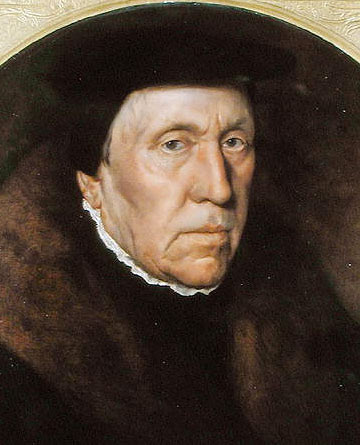
Jan van Scorel grew up at the crossroads of two worlds. Behind him lay the northern tradition — the one in which van Eyck taught painting to see every thread on a cloak and every glint on glass, where the world was rendered with an almost prayerful meticulousness. Before him lay the south, of which the North knew more by hearsay than by sight: Italy, antiquity, a new sense of volume and space. Scorel did not stay on one shore — he set out to seek the other.
The road proved long. He traveled across Europe to the east and the south, and at a certain point joined a pilgrimage to Jerusalem — following a path that for many remained a lifelong dream. The Holy Land, eastern landscapes, unfamiliar horizons — all of it settled into the artist's memory and would later return in his paintings as details a northern studio could never have invented.
On the way back, Italy detained him. In Rome he found the brief reign of Adrian VI — the only pope of Netherlandish birth — who drew his countryman close. Scorel was entrusted with the care of the ancient antiquities of the Vatican: he became keeper of a collection of marbles among which more than one generation of masters had learned to look. Here in Rome, too, the fame of Raphael was in the air, and the Italian manner — clear composition, the corporeality of figures, the breath of antiquity — entered the northerner's eye for good.
He brought home not souvenirs but a new way of seeing. What the North painted flat and detailed, Scorel began to build in volume: bodies took on weight, space took on depth, and faces took on an antique assurance. He did not renounce the Netherlandish love of detail, but subordinated it to the Italian sense of the whole. So on Dutch soil there took root what had flowered beyond the Alps.
At Utrecht his fate split in two — and he bore that division calmly. Scorel became a canon, a man of the Church, and at the same time remained a sought-after painter. Priest and master in one person, he painted altarpieces and portraits, combining prayerful service with a craft that demanded paints, commissions and a workshop.
His particular invention was the group portrait of Jerusalem pilgrims. People who had walked the same road as he had, Scorel arranged in a row, like a brotherhood marked by a shared experience of the Holy Land. This was almost a new genre for the North: not saints, not donors at the feet of the Madonna, but living contemporaries, united not by lineage or guild but by a journey they had endured.
In the history of northern painting Scorel stands as a bridge. On one side lies the heritage of van Eyck and the old Flemings; on the other, the Italian manner, which he was the first to transfer intelligibly to his homeland. Through his workshop and his example a new generation of Netherlandish painters learned to join northern sharpness of eye with southern breadth — and it is from that union that much of what we call the Netherlandish Renaissance begins.