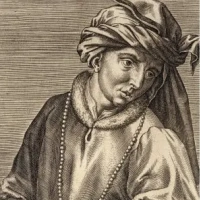
He did not invent oil painting — but it was he who understood what could be done with it. Before him painters worked in tempera: the paint dried fast, and details had to be simplified. Oil dried slowly — one could work in layers, achieve transparency, luminosity, an almost photographic precision. What in others remained a technique became, in him, a language.
Little is known about the artist himself. Jan van Eyck was born around 1390 — the exact date is unknown. He worked at the court of Philip the Good, Duke of Burgundy: first as a painter, then as a diplomat, traveling on missions to Portugal and Spain. At the origins of the Netherlandish school, beside him stood Robert Campin — but it was van Eyck who first made paint hold the light.
The Ghent Altarpiece — 1432. Twelve panels, more than two hundred figures. It is the earliest signed and dated painting of the Netherlandish school. One can study it for hours: every flower in the field is painted separately, every thread in a garment is distinct. There are no perfunctory passages here — everything is worked out with the same attention, as if the artist had no right to simplify a single thing.
The Arnolfini Portrait — 1434. A merchant and his wife stand in a room. On the far wall is a round convex mirror, and in it the whole room is reflected, and with it the artist himself. This is the first instance in European painting of a master placing himself inside the picture, in the reflection. Painting looked back, for the first time, at the one who paints it.
In the second row, above the mirror, is an inscription on the wall: "Johannes de Eyck fuit hic 1434" — "Jan van Eyck was here." The first signature in the history of Netherlandish painting. Not the mark of a master craftsman beneath a commission, but a testimony of presence: I stood here, I saw this, I answer for it.
Behind this obsession with precision lies not the vanity of the eye but a particular attitude toward matter. If every thread and every gleam is worthy of being painted to the end, then the material world itself has ceased to be a rough draft. The utmost distinctness of the earthly here sounds like an icon of that which has entered matter truly and bodily: not an idea but flesh, not a hint but a thing you can examine up close.
He died in 1441. Rogier van der Weyden, his successor, came to the workshop — and saw how painting ought to be done. From that workshop came all the later painting of the North: the ability to render the world so that the viewer believes in its substance before he has time to ask about its meaning.