The angel comes to Mary not in a temple, nor in a cloud of golden light, but in a cramped burgher's room. On the table lies an open book; against the wall hangs a brass washbasin; a candle has just been snuffed out; through the window a Flemish town can be seen. This is how, in the Mérode Altarpiece, Robert Campin paints the Annunciation: the greatest of tidings, in the middle of an ordinary day.
Campin was born around 1375 in Valenciennes — once the flourishing capital of the county of Hainaut. For several years he studied painting in Dijon, and from 1418 to 1432 he kept a workshop in Tournai, from which outstanding Netherlandish masters emerged — Rogier van der Weyden and Jacques Daret. Scholars suppose that Campin may also have met another famous contemporary, Jan van Eyck, who was then living in Lille. Campin is often called the founder of the painting tradition of the Northern Renaissance.
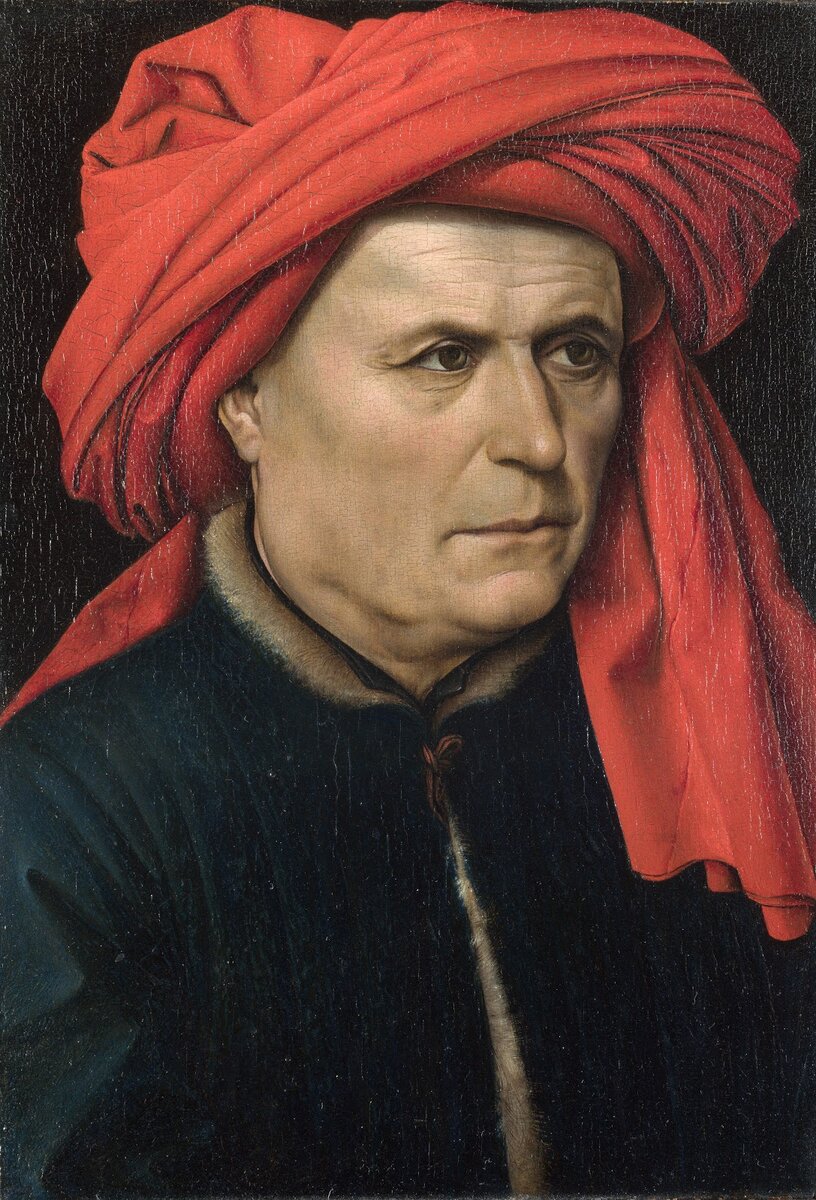
Studying Campin's legacy is difficult: not a single painting bears his signature. By the rules of the medieval workshop, the master only sketched out the composition and drew the faces, while the rest was finished by his pupils; several copies were made of finished works — by the master's hand and by his apprentices' alike. The attribution of every work ascribed to him is therefore disputed. His circle is usually credited with the three panels of the Flémalle Altarpiece — The Holy Trinity, The Virgin and Child, and Saint Veronica — the two panels of the Werl Altarpiece in the Prado in Madrid, the Portrait of a Man in a Red Turban in the National Gallery in London, and the Mérode triptych in the Metropolitan in New York.
Campin stands at the source of the so-called "Flemish Primitives." His manner is recognizable by its meticulous, almost tangible fidelity — both to people and to the things around them. In his work, everyday details are not a backdrop but the very fabric of the picture: they overshadow, and even wholly displace, the marks of holiness familiar to religious painting. On his panels there is no golden background and no halo above the saints.
Behind this lies more than a taste for precision. To remove the gold and the halo is to say that the sacred no longer hovers above the world, apart from it, but enters the world completely. Christianity says an incredible thing: the eternal became flesh, entered human daily life with all its cramped ordinariness. A room with a washbasin and a snuffed-out candle — this is the Incarnation as seen by the painter's eye: heaven descends into the house, and it is easy to fail to recognize it, because it comes as one of our own.
Campin was also one of the heralds of the European portrait. His sitters — the local nobility — are shown in three-quarter turn, the face occupying almost the whole panel and gazing at us directly, as if alive. The same gaze he gave the Madonna in the burgher's room he also gave to an ordinary man of his own city.
He lived in troubled times — at the height of the rivalry between the Duke of Burgundy and the King of France. Campin took the king's side, for which he was repeatedly subjected to legal prosecution. He died in 1444 in Tournai, leaving behind a body of painting that had learned to see the sacred where before only the everyday had been seen.