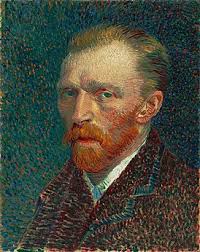
In his lifetime he sold one painting. The Red Vineyard, for four hundred francs. That was a few months before his death.
Vincent van Gogh was born in the Netherlands in 1853, the son of a pastor. He tried everything: he worked in a gallery, taught school, preached in the Belgian coalfields — living among the miners and giving away his belongings until he had nothing left himself. At twenty-seven he decided he would be a painter.
He learned fast and fiercely. He copied Millet, studied Japanese prints, and corresponded with his brother Theo — a correspondence running to several volumes, and it explains him better than any biography.
In 1888 he went to Arles, in the south of France, chasing the light. He rented the Yellow House and invited Gauguin. Two months later: a quarrel, a severed ear, a psychiatric hospital. What exactly happened that night, no one knows for certain to this day.
Over the next two years — in the hospital and after it — he painted more than three hundred works. The Starry Night, Irises, Wheatfield with Crows. He painted quickly, almost in a trance, several pictures a day.
In July 1890, at Auvers-sur-Oise, he walked out into a field and shot himself in the chest. He lived another thirty hours. Theo died six months later.
Today The Starry Night is one of the most recognizable paintings in the world; at auction the price runs to tens of millions. One painting sold in his lifetime. Four hundred francs.