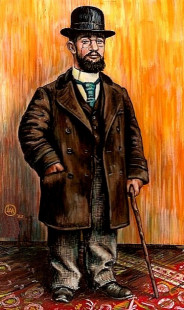
He stood barely five feet tall — one meter fifty-two. A childhood bone disease broke both his legs, and they never grew again. In the cabarets and brothels of Paris everyone knew him — and nobody paid him any attention. That was his advantage.
Henri de Toulouse-Lautrec was born in 1864 into an aristocratic family: a count, of ancient lineage. And unlucky genes — his parents were cousins. He had drawn since childhood, in the years when his legs allowed little else. His parents did not object: let him draw, so long as it kept him from suffering.
At twenty he moved to Montmartre. A studio, the Moulin Rouge, the circus, the races. He drew what he saw every day: dancers, cabaret singers, clowns, patrons at their tables, women in the rooms of brothels. He lived in one of those houses for several years — paid for his room, and drew its inhabitants without a trace of romance: tired, bored, simply alive.
His posters changed the history of graphic art. La Goulue, Jane Avril, Yvette Guilbert — he made them stars. His posters went up all over Paris, and people tore them off the walls to carry home. It was advertising as art.
The technique: quick lines, flat patches of color, no idealization. He learned it from Japanese prints — from Hokusai and Utamaro. The silhouette matters more than the shadow.
At thirty-six, alcohol nearly drove him out of his mind. His father took him away to the family château. A year later he was out. A year after that he was dead — at thirty-six.
The Moulin Rouge is open to this day. On its billboards: his style.