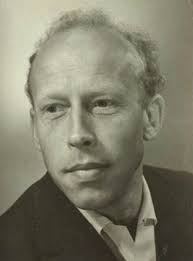
Vladimir Fyodorovich Tendryakov was born in 1923 in the village of Makarovskoye, in Vologda Oblast. In 1941, having just finished school, he went off to fight. After demobilization he worked as a teacher and as secretary of the district Komsomol committee in the countryside — an experience that rooted him in the life he would later write about. In 1951 he graduated from the Gorky Literary Institute in Moscow. He made his debut with stories in which rural life appeared not as a backdrop for ideology but as a place inhabited by real people with real interests.
The first major scandal came in 1956 with the novel "The Tight Knot": the story of a collective-farm chairman who collides with a system that cannot be corrected from within. The novel was printed, but it was furnished with an afterword explaining to the reader precisely where the author had gone wrong. This was standard Soviet procedure: the text would appear, but accompanied by the editorial board's collective censure. Tendryakov gained readers — and, at the same time, a reputation as an inconvenient author.
In 1958 "The Miraculous Icon" appeared — a novella about what happens in a Soviet village when an old icon is found and a rumor of a miracle spreads. Tendryakov mocks neither faith nor atheism. He examines how faith arises wherever there is emptiness — and how official ideology tries not to notice that emptiness. The characters of the novella are not symbols but people who are afraid both to believe and not to believe. This made "The Miraculous Icon" an uncomfortable text on both sides of the ideological divide.
Tendryakov is conventionally classed among the "village prose" writers — alongside Valentin Rasputin, Fyodor Abramov, and Vasily Belov. But his village is not a nostalgic one. "Three Sacks of Weedy Wheat" (1973) tells of a chairman forced to choose between telling his superiors the truth and the survival of the collective farm: he has no good way out, only a bad one and a worse one. "The Night After Graduation" (1974) tells of schoolchildren at the moment when the system stops protecting them and they discover that no one has taught them how to be adults. In both cases Tendryakov poses a single question: what does a person actually do when doing right is dangerous?
Much of what he truly believed, Tendryakov wrote "for the drawer." After his death in August 1984, texts were published that had been impossible under Soviet censorship: novellas about the Stalin era, memoirs of his meetings with Khrushchev — candid to a degree unthinkable in Soviet publicism — and texts about the religious life of the Soviet village. The posthumous publications changed his reputation: it turned out that what had been printed in his lifetime was only a fraction of what he had written.
His place in twentieth-century literature is defined neither by his belonging to the "village writers" nor by any closeness to the Sixtiers — he is not wholly one or the other. Tendryakov was engaged in what might be called moral examination: he tested how conscience and cowardice operate under real circumstances, without idealization and without verdict. This is precisely why his prose remains readable long after the Soviet context has flaked away: the situations have become dated, but the questions have not.