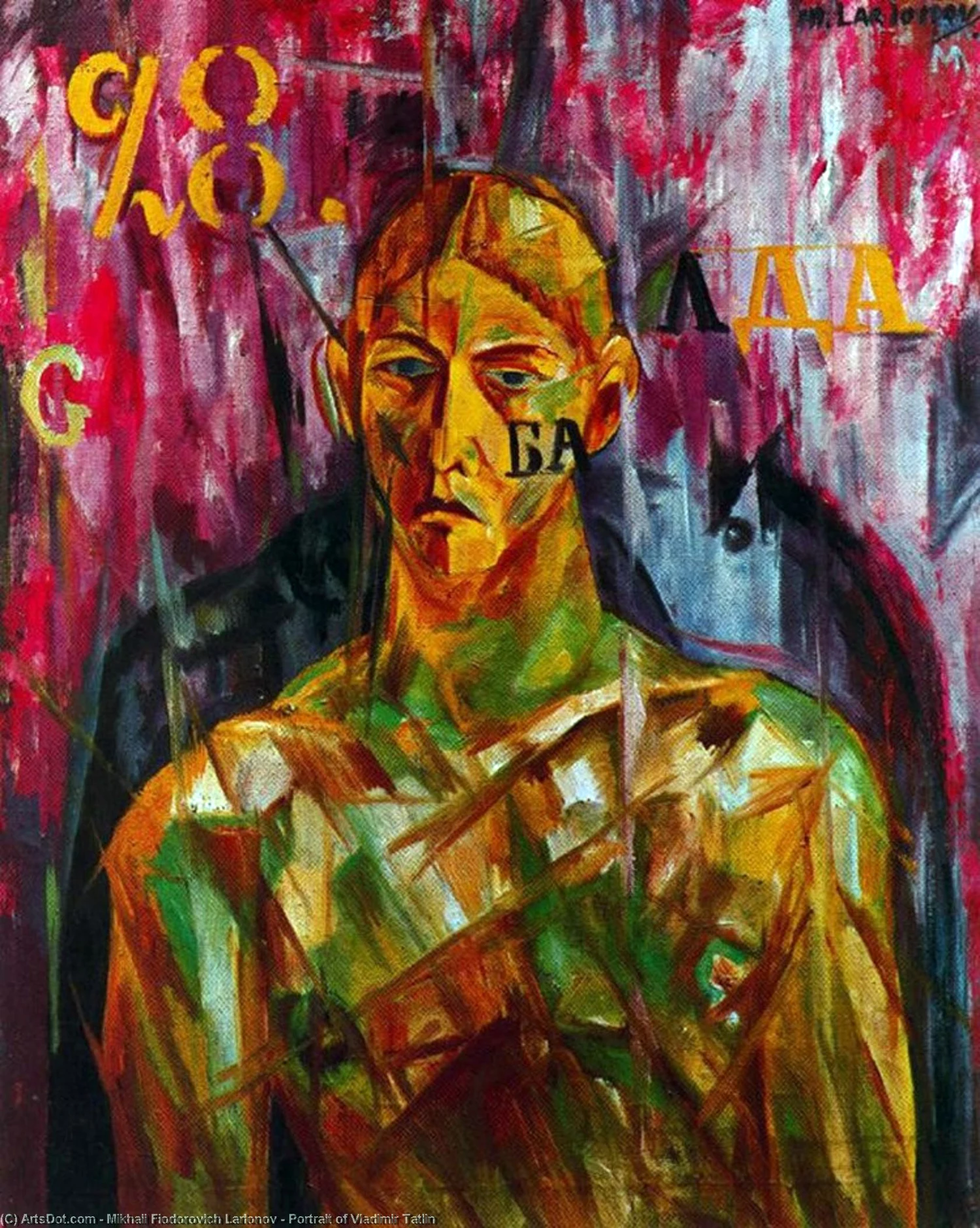
Velimir Khlebnikov on Tatlin:
Tatlin, secret-seer of blades,
stern singer of the propeller,
one of the squadron of sun-catchers.
The cobwebbed vale of rigging
he bound with an iron horseshoe,
with a dead hand.
Tongs turned to second sight.
The blind fall dumb and stare
at what he has shown them:
so unheard-of, so prophetic,
these tin things of the brush.
(Late May 1916)
Vladimir Yevgrafovich Tatlin (28 December 1885, Moscow — 31 May 1953, Moscow) was a painter, graphic artist, designer, theatrical artist, author of utopian architectural projects, an innovator of the Russian avant-garde, and a constructivist.
What set Tatlin's art apart: he was one of the pioneers of the Russian avant-garde, placing material, volume, and construction at the very center of the work of art. He entered history as the creator of the Monument to the Third International, inside whose load-bearing frame rotating functional volumes of glass and metal were to be housed — a cube, a cylinder, a pyramid, and a hemisphere. The openwork frame of "Tatlin's Tower" became the visiting card of constructivism, one of the great emblems of the new Russian art. It caused a sensation at the world exhibition of art in Paris in 1925, but the 400-meter building was never realized.
His best-known works: Tatlin's Tower, or the Monument to the Third International; Sailor (A Self-Portrait); and the model of the flying machine Letatlin.
His father, Yevgraf Nikiforovich Tatlin, a hereditary nobleman, was a railway engineer; his mother, the poet Nadezhda Nikolaevna Bart, died early — the boy was only eleven. The family moved to Kharkov, and his father soon remarried. Vladimir entered the Kharkov realschule, where his drawing master was the academic painter Dmitry Bespierchy. Three years later, worn down by constant conflict with his stepmother, he ran away from home and headed south, to Odessa. He became a cabin boy and spent several years at sea, but the love of drawing won out: in 1902 Tatlin came to Moscow and entered the Moscow School of Painting, Sculpture and Architecture. He did not last long — he was expelled for poor progress and "objectionable conduct." He then made one more attempt to bind his life and fate to the sea, enrolling at the Odessa school of merchant seamanship. And once again the wish to be an artist prevailed: in 1905 he went to Penza and entered the art school there, where he studied for five years. His teachers were Alexander Vakhrameev and his beloved Alexei Afanasyev.
Tatlin began exhibiting in 1909, taking part in the salons of the Moscow journal The Golden Fleece. In 1910 he received his diploma as a draughtsman, and in the same year he met Mikhail Larionov, who introduced him to the avant-garde currents. The two artists' views soon diverged, though both remained within the channel of the "new art." Tatlin exhibited widely and grew absorbed in the theater — designing, among other things, costumes and sets for Glinka's opera A Life for the Tsar. In 1912 he took part in the third exhibition of the Union of Youth in St Petersburg and, in Moscow, in the shows of the Jack of Diamonds and the Donkey's Tail.
In 1914, as a bandura player, Tatlin took part in a Russian exhibition of handicrafts in Berlin, then traveled on to Paris, where he visited Picasso's studio. A year later, at the Last Futurist Exhibition "0.10," he showed his brainchild — the so-called "material assemblages," which he later named counter-reliefs: spatial constructions built of various materials. Developing the new direction, Tatlin coined his own terms for the "tension" and "strain" of a construction, and demanded that the viewer "place the eye under the control of touch."
In 1916 he met Velimir Khlebnikov, who dedicated to him the poem "Tatlin, secret-seer of blades"; he was friendly with the Burliuk brothers and with Vladimir Mayakovsky.
The Revolution Tatlin accepted without reserve. He headed the Moscow art collegium of the Visual Arts Department of the Commissariat of Enlightenment, worked on the Commission for the Protection of Monuments of Art and Antiquity, and later directed workshops at the Free State Art Studios; a number of his works were acquired by the Tretyakov Gallery and the Russian Museum.
Moving to Petrograd in 1919, Tatlin took charge of the studio of material, volume, and construction at the state art studios there. At the same time he set about realizing his famous project, the Monument to the Third International. The innovative model, conceived in the spirit of constructivism, was presented to the public at the end of 1920. The unprecedented structure met a divided reception. The project remained unbuilt — as did the flying machine he designed in 1929–1932.
In 1925 Tatlin was made a professor; he taught at the Kiev Art Institute and, from 1927 to 1930, at VKhUTEMAS, and received the title of Honored Art Worker of the RSFSR. "A thing should be sturdy, useful, and beautiful," he proclaimed; he designed a model coat for the Leningrad clothing trust and created the famous "Tatlin chair," which entered every textbook of furniture design.
In 1933 Tatlin met a gifted young artist, Alexandra Nikolaevna Korsakova-Rudovich (1909–1990), who became his lawful wife.
After the failure of the Letatlin project, disillusioned with object-making, the artist returned to painting and devoted the following decade to stage design and book illustration. He loved the theater as passionately as he loved the sea. As early as 1923 he had staged Zangezi, after Khlebnikov, serving as its designer and reciter as well. During the war years Tatlin lived in Moscow designing productions — more than twenty-five stagings in all.
In the postwar years the artist was criticized for formalism. In the 1950s he worked in a studio engaged in decorating the Moscow State University building and producing visual teaching aids. He died in 1953.