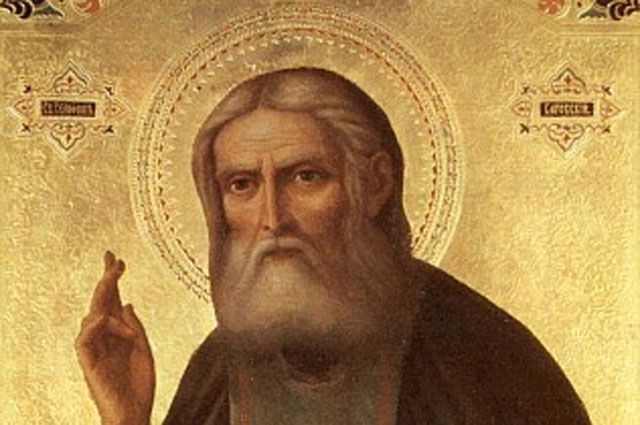
Saint Seraphim of Sarov — Prokhor Moshnin in the world — was born on 19 July 1759 in the town of Kursk, to Isidor and Agafia Moshnin, devout Christians. Blessed with an excellent memory, Prokhor learned to read early. From childhood he loved to attend the church services and to read Holy Scripture and the Lives of the Saints to companions of his own age; most of all he loved to pray, or to read the Holy Gospel, in solitude. In his twentieth year he entered the Sarov hermitage as a novice. There, having passed through the usual round of monastic obediences, he was tonsured a monk in 1786 by the superior of the monastery, Father Pachomius, and given the name Seraphim — "fiery." In October of the same year he was ordained hierodeacon by Victor (Onisimov), Bishop of Vladimir. For seven years he served zealously as deacon, and on 2 September 1793 he was ordained hieromonk by Theophilus (Raev), Bishop of Tambov. Declining election as superior, Seraphim soon after his ordination withdrew into the forest, to labour there in strict fasting, silence, bodily toil and unceasing prayer. Seeking still severer feats, in order to purify his heart and behold God, he went into seclusion. Through the long years of hermit life and enclosure, as the ascetic's heart filled with love for God, there opened in him a particular love for people as well. More than once he was granted visions and singular manifestations of God's mercy that strengthened him in his labours, and the Lord bestowed on the elder gifts of grace: clairvoyance, consolation, and the healing of souls and bodies.
On 25 November 1825 the Mother of God, together with Saints Clement of Rome and Peter of Alexandria, whose memory is kept that day, appeared to Seraphim in a dream-vision and commanded him to come out of seclusion and to receive all who sought instruction, comfort, guidance and healing. From that time the roads and paths leading to Sarov came alive. "My joy" — with these words Seraphim greeted everyone who came to him. A single word of his could warm the most hardened and calloused hearts, awakening in them a "warmth of heart" — a striving toward goodness and God which turns even sinful people to repentance and inner transfiguration. His inner sight penetrated souls so deeply that in every person, in whatever state he arrived, the saint saw the features of the image of God, saw what that person might become, and rejoiced in his hidden beauty.
Though he had passed his whole life in extraordinary ascetic labours, he counselled the "royal," that is, the middle way, and warned against taking on deeds beyond one's strength. "Fasting, prayer, vigil and every other Christian work," he said, "however good in themselves, are not in their mere performance the aim of our Christian life, though they serve as means to attain it. The true aim of our Christian life is the acquisition of the Holy Spirit of God." The chief means of acquiring the Holy Spirit he held to be prayer. "Every virtue done for Christ's sake gives the blessings of the Holy Spirit, but ... prayer more than anything brings the Spirit of God, and it is the easiest of all for anyone to practise." He did not consider long rules of prayer obligatory, yet he insisted strictly that prayer must not be formal: "Monks who do not join inner prayer to the outward are not monks but blackened firebrands!" During the services in church he advised standing with closed eyes, or looking at an icon or a burning candle; and in expounding this thought he offered a beautiful comparison of human life to a wax candle.
Famous is his rule of prayer for laypeople who, because of the difficulties of their lives, cannot read all the customary morning and evening prayers. It is this: in the morning, before dinner and in the evening, to say the Lord's Prayer three times and "Rejoice, O Virgin Theotokos" three times, and the Creed once. While going about one's necessary work, he advised saying from morning until dinner the Jesus Prayer — "Lord Jesus Christ, Son of God, have mercy on me a sinner," or simply "Lord, have mercy" — and from dinner until evening, "Most Holy Theotokos, save me a sinner," or "Lord Jesus Christ, through the Theotokos have mercy on me a sinner." "In prayer attend to yourself," the ascetic said, "that is, gather the mind and unite it with the soul. At first, for a day, two days or more, say this prayer with the mind alone, attending separately to each word. Then, when the Lord warms your heart with the warmth of His grace and unites it within you into one spirit, the prayer will flow in you without ceasing and will be with you always, delighting and nourishing you." Fulfilled with humility, he taught, this rule can bring one to Christian perfection even in the life of the world. Reading through the whole New Testament every week, the Sarov ascetic instructed: "The soul must be provisioned with the Word of God. Above all one should exercise oneself in reading the New Testament and the Psalter. From this comes enlightenment of the mind, which is changed by a divine change."
Communing of the Holy Mysteries of Christ every Sunday and every feast without fail, Seraphim, when asked how often one should approach Communion, answered: "The more often, the better." To Vasily Sadovsky, priest of the Diveyevo community, he said: "The grace given us by Communion is so great that however unworthy and however sinful a man may be, if only in humble awareness of his utter sinfulness he approaches the Lord who redeems us all, though he be covered from head to foot with the wounds of sin, he will be cleansed by the grace of Christ, grow brighter and brighter, become wholly radiant, and be saved... I believe that by the great goodness of God grace will be shown even upon the family of the communicant..." Yet he did not give everyone the same instruction about frequent Communion. Many he advised to prepare and commune in all four fasts and on all twelve great feasts. He warned that one may also commune to one's own condemnation. "It happens sometimes," he said, "that here on earth people commune, yet with the Lord they remain uncommuned!" But one who communes reverently, and not merely once a year, said the saint, "will be saved, will prosper, and will be long-lived upon the very earth."
Reverence toward what is holy the saint of God required always and everywhere, and above all he held reverence necessary in church. "And everything you do in it (the church)," he said, "how you enter and how you leave — all must be done with fear and trembling and with never-ceasing prayer; and in church nothing should ever be spoken but what is strictly necessary and what concerns the Church. And what is more beautiful, higher and sweeter than the Church! Whom indeed should we fear in her, and where shall we rejoice in spirit, in heart and in all our thought, if not in her, where the Lord and Master Himself is always present with us." In these words Seraphim conveyed his deep spiritual experience of the grace of real, living communion with God in the temple. "There is no worse sin, and nothing more terrible and ruinous, than the spirit of despondency," he said. He himself was never gloomy or dejected. "Cheerfulness is not a sin," the elder told the head of the Diveyevo community; "it drives away weariness, and from weariness comes despondency, and there is nothing worse — it brings everything else with it... To say a kind, friendly, cheerful word, so that before the face of the Lord everyone's spirit be always glad and not despondent, is no sin at all, matushka." He himself always shone with spiritual joy, and with that quiet, peaceful joy he filled to overflowing the hearts of those around him, greeting them with the words: "My joy! Christ is risen!" Every burden of life grew light near the ascetic, and a multitude of the sorrowing and the seekers of God pressed constantly about his cell and his forest hermitage, wishing to share in the grace that poured forth from the saint of God. Before the eyes of all was confirmed the lofty truth he had spoken: "Acquire peace, and thousands around you will be saved." This commandment on the acquisition of peace leads up to the teaching on the acquisition of the grace of the Holy Spirit, and is an important step on the path of spiritual growth. Having passed in his own experience through the whole ancient science of Orthodox ascetic struggle, Seraphim expressed his experience of "life in God" in his instructions. They express the Church's common path of ascetic endeavour and are close in content to the Philokalia; they contain many references to the holy fathers, above all to Saints Isaac the Syrian and Barsanuphius the Great.
Along with God's other gifts, Seraphim had the gift of foresight. The future of Russia, down to the end of the age, was revealed to him. Russia, in his words, "will always be glorious and terrible to her enemies, and invincible." Foreseeing what the spiritual labour of coming generations would be, he taught the search for peace of soul and the judging of no one: "He who walks in a peaceful frame draws spiritual gifts as if with a spoon... For the preservation of peace of soul... one must by every means avoid judging others... To be delivered from judging, one must attend to oneself, receive alien thoughts from no one, and be dead to everything."
Seraphim may rightly be called a disciple of the Mother of God. Three times the Most Holy Theotokos healed him of mortal illness. In his youth he fell so gravely ill that every means of treatment proved powerless. His body lay in fever, but his pure soul burned in prayer to the Intercessor of all who sorrow and are burdened. During a brief sleep the Mother of God appeared to him and promised to heal him. Waking, the boy told his mother all that he had seen. Soon a procession of the cross passed by their house, bearing a wonder-working image of the Theotokos. A sudden downpour forced the solemn procession to take shelter in the house of Seraphim's parents. The perceptive mother at once understood the meaning of the wondrous visitation and with deep faith held her ailing son to the wonder-working face of the Mother of God. At once the sickness left the young boy's body.
The second miraculous healing came in 1783, while he was fulfilling a monastic obedience at the Sarov monastery. The Lord again visited the novice with grave illness, trying his patience and meekness. He stretched out his hands to heaven and begged the Mother of God to strengthen him in bearing the heavy trial. And the Queen of Heaven looked upon her faithful servant. For his humility Seraphim was granted a visitation of the Most Holy Theotokos: overshadowed by the radiant light of the Most Pure Virgin Mary, he found himself entirely well.
In 1804, during his solitary struggle in the forest, he was beaten half to death by robbers who imagined they would find money in his cell. None of the monastery's brethren any longer hoped to see him alive, and they awaited his end with sorrow. But by a miraculous visitation of the Mother of God the dying elder was raised again from his sickbed and received spiritual and bodily strength for further monastic labours.
The Mother of God appeared to Seraphim many times, instructing and strengthening him. At the very beginning of his path he heard her say to the Apostle John the Theologian, pointing to him as he lay on his sickbed: "This one is of our kind."
Much of his strength the saint gave to the establishment of the women's monastic community at Diveyevo, founded at the direction of the Mother of God; he himself said that he gave not a single instruction of his own, but did everything at the will of the Queen of Heaven. Saint Seraphim charged the sisters always to honour the Most Holy Theotokos for her innumerable mercies to Orthodox Christians. On 25 March 1831, the feast of the Annunciation, the eldress Eupraxia of the Diveyevo monastery witnessed an appearance of the Mother of God to Seraphim. During the appearance the Mother of God asked him to be spiritual guide to the sisters of the Diveyevo monastery and promised him her heavenly help in this.
After his death the Diveyevo convent preserved his especially venerated cell icon of the Mother of God, "Tenderness," before which he had turned in fervent private prayer. With oil from the lamp that burned before this treasure of his cell Seraphim anointed the sick, and they received healing. Uncreated divine light shone from the icon of the Mother of God "Tenderness," transfiguring the ascetic's soul into a most pure vessel of God's grace. After fervent night prayer to the Theotokos before her wonder-working icon, an inexpressible light of divine grace poured from his transfigured face, illumining those who came to him. This icon of the Most Holy Theotokos Seraphim of Sarov often called "the Joy of All Joys."
The feast of the "Tenderness of Seraphim-Diveyevo" icon of the Mother of God was appointed for 28 July, probably because on that day the Church keeps the memory of the holy Apostle Prochorus, whose name Seraphim had borne in baptism.
On 1 January 1833 Seraphim came for the last time to the church of Saints Zosima and Sabbatius for the Divine Liturgy and communed of the Holy Mysteries of Christ, after which he blessed the brethren and bade them farewell, saying: "Save your souls, do not lose heart, keep watch: this day crowns are being prepared for us." The next day he departed peacefully to the Lord, whose faithful servant he had been all his life.
Seventy years later, in 1903, he was glorified among the saints. On 19 July, the saint's birthday, his holy relics were uncovered with great solemnity and laid in the shrine prepared for them. By God's mercy the long-awaited event was accompanied by many miraculous healings of the sick.
Venerated by the Orthodox people even in his lifetime, Seraphim became one of the best-loved saints of the Russian people, as Saint Sergius of Radonezh had before him. Not long before his blessed end a devout monk asked him: "Why do we not lead so strict a life as the ascetics of old?" "Because," Seraphim answered, "we lack the resolve. Had we the resolve, we would live as our fathers lived; for the grace and help given to the faithful, and to all who seek the Lord with their whole heart, is now the same as it was of old, since, in the word of God, the Lord Jesus Christ is the same yesterday and today and forever" (Heb. 13:8).