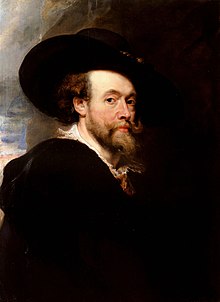
He worked like a factory. The workshop, the assistants, the pupils — everything was organized to produce paintings at maximum speed. Rubens would sketch the composition, the pupils would work up the details, and he would return to finish the faces and hands. And yet every picture was alive.
Peter Paul Rubens was born in 1577 in Siegen — his father had fled Antwerp to escape religious persecution. After the father's death the family returned. Rubens grew up at court, mastered six languages, and read the ancients in the original. Painting was his calling, but not his only one.
In 1600 he left for Italy — for eight years. He copied Titian, Michelangelo, Tintoretto, and worked for the Duke of Mantua. He returned to Antwerp in 1608 — and at once became the most celebrated painter in Northern Europe.
His world is flesh, motion, passion. His bodies do not stand still — they lunge, fall, embrace. The Rape of the Daughters of Leucippus, The Lion Hunt, The Descent from the Cross — everything in movement, everything at full pitch. He could paint terror and tenderness in the same breath.
Beyond painting, he was a diplomat. He served the Spanish crown and travelled to London to negotiate peace between Spain and England. The English king knighted him. So did the Spanish one.
In 1630, at fifty-three, he married a second time — the sixteen-year-old Helena Fourment. He painted her dozens of times. Het Pelsken, "The Little Fur," is the most intimate portrait of all: his wife standing naked, wrapped in a fur cloak. He left instructions that the picture was not to be sold after his death.
He died in 1640. The picture, of course, was sold.