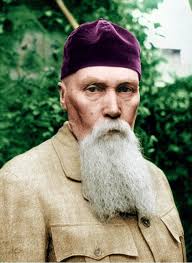
Nikolai Konstantinovich Roerich was born on 9 October 1874 in Saint Petersburg, into a notary's family. He entered the Imperial Academy of Arts, where he studied under Arkhip Kuindzhi — a landscape painter famous for the ability to render light so vividly that viewers suspected him of using special paints. Alongside painting, Roerich completed the law faculty of the university and became fascinated with archaeology, taking part in the excavation of ancient burial mounds.
Early fame came to him as a theatre designer: he made sets and costumes for Diaghilev's "Ballets Russes" in Paris, including the scandalous premiere of "The Rite of Spring" in 1913. Already then his painting combined an interest in antiquity and the East with a monumental, almost poster-like manner of writing in bright planes of color.
After the revolution Roerich found himself abroad — first in London, then in the United States — and it was there, in 1923, that he began preparing the chief enterprise of his life: the Central Asian Expedition. Through India, Tibet, Xinjiang, the Gobi and Taklamakan deserts, through Mongolia and the Altai, he and his family covered some twenty-five thousand kilometers, crossing thirty-five high mountain passes. The expedition lasted five years, from 1923 to 1928, and combined archaeological and ethnographic research with the work of a painter: in that time Roerich produced about five hundred pictures, and from the journey he wrote the books "Heart of Asia" and "Altai — Himalaya."
Returning from the expedition, Roerich and his wife Helena Ivanovna settled in the Kullu Valley in the Indian Himalayas, where they founded the Urusvati Himalayan Research Institute — the name translates from Sanskrit as "the Light of the Morning Star." Here the couple carried on scientific work and developed their own philosophical teaching about the interconnection of culture, nature, and man's inner life, which they called Living Ethics.
Anxiety for the fate of cultural monuments amid new and ever more destructive wars led Roerich to the idea of an international treaty for their protection. The pact he proposed, for the protection of artistic and scientific institutions and historic monuments, was signed in 1935 by twenty-one countries of the American continent; the distinguishing sign of the protected sites, the Banner of Peace — three red circles on a white field — Roerich designed himself. The ideas of the pact later formed the basis of the Hague Convention for the Protection of Cultural Property in the Event of Armed Conflict.
Roerich kept painting into the last years of his life — the Himalayan series in his legacy numbers more than two thousand canvases, the snowy peaks and monasteries almost always rendered by one and the same device: broad planes of saturated, pure color, without fine detail, as though the mountain mattered not as a landscape but as a symbol. He died in December 1947 at his estate in the Kullu Valley, from which he never returned from his last great expedition — to Russia, which he had left a quarter of a century before.
Behind Roerich lay a path rare in the history of painting: a pupil of a Wanderer landscapist became a theatre designer of world rank, then a polar traveler and explorer, and finally the author of an international legal document. None of these roles was accidental for him — in all of them he was moved by one and the same thought: that the monuments of culture belong not to a single country but to all humanity, and therefore deserve protection on a par with human life.