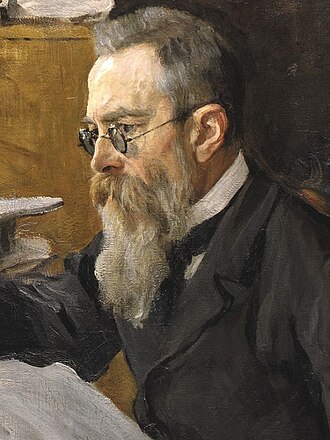
Nikolai Andreyevich Rimsky-Korsakov (1844–1908) was a Russian composer, one of the “Mighty Handful,” the supreme master of orchestration in his day and the teacher of an entire generation of Russian composers. He began not as a musician but as a naval officer: at seventeen he set out on a three-year voyage around the world aboard the clipper Almaz, and the memory of the sea stayed in his music for the rest of his life.
Entering Balakirev's circle alongside Borodin, Mussorgsky and Cui, Rimsky-Korsakov first studied hard on his own — and then spent a lifetime teaching others: through his class at the Petersburg Conservatory passed Lyadov, Glazunov, Stravinsky, Prokofiev, Respighi. His Principles of Orchestration long remained the standard textbook the world over. It was he, too, who completed, edited and orchestrated much of Mussorgsky and Borodin — without him we would not know their music in its present form.
His principal works are operas drawn from Russian fairy tale and history: The Snow Maiden, The Tsar's Bride, Sadko, The Tale of Tsar Saltan, The Legend of the Invisible City of Kitezh, The Golden Cockerel. From Tsar Saltan came the famous “Flight of the Bumblebee.” The symphonic suite Scheherazade (1888), with its violin solo for the storyteller, remains to this day a model of orchestral narrative, and the Capriccio Espagnol a score of such colour that every future orchestral colourist studies it.
Beyond his music he left a detailed autobiography, the Chronicle of My Musical Life — a rare first-hand document of the nineteenth-century Russian school of composition, in which a dry seaman's style joins with memories of Glinka, Balakirev, Mussorgsky, Tchaikovsky.
To listen to Rimsky-Korsakov is to hear the Russian fairy tale translated into the most brilliant and colourful orchestral language of the nineteenth century.