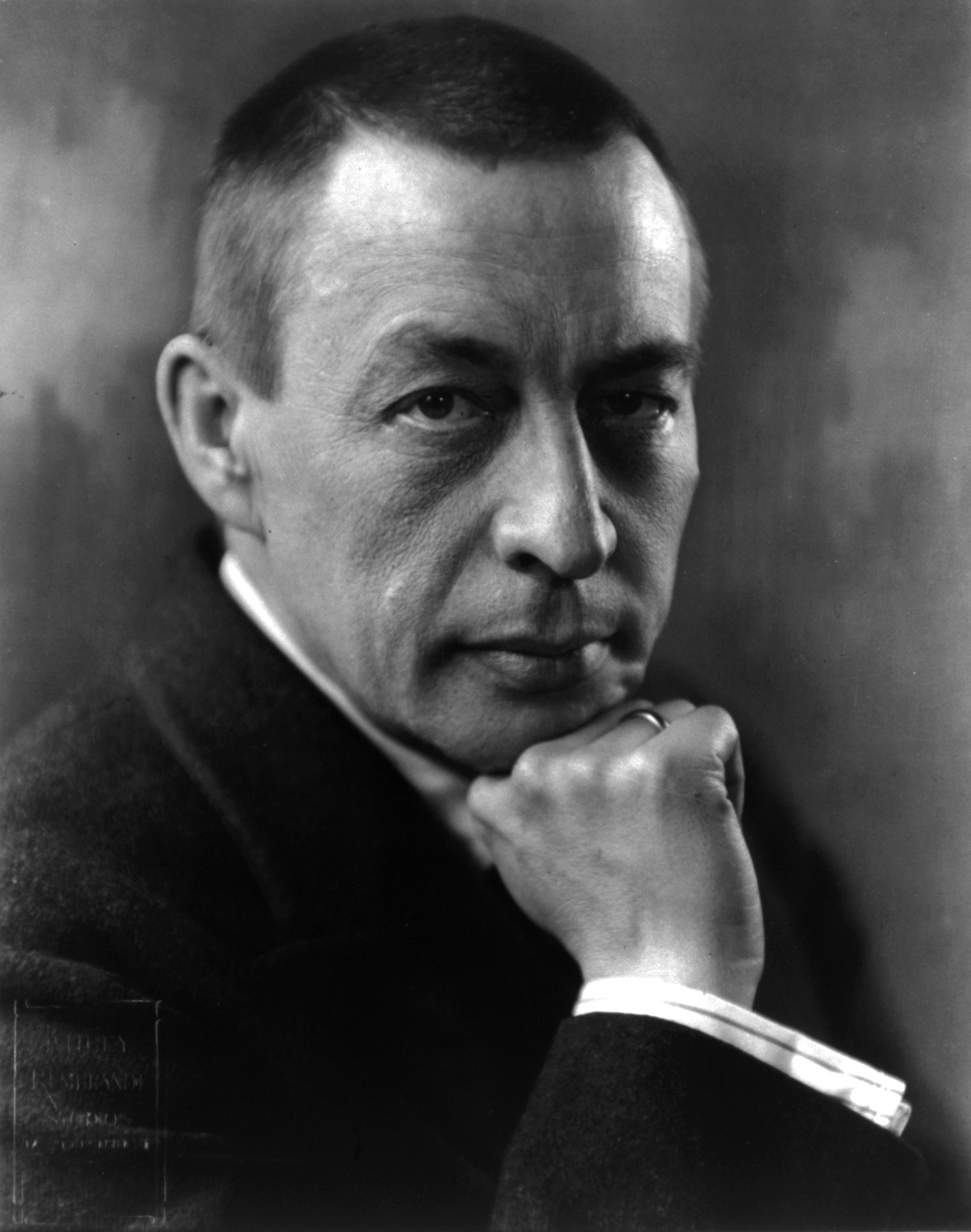
Sergei Vasilyevich Rachmaninoff (1873–1943) — Russian composer, pianist and conductor, one of the last great Romantics and the greatest Russian pianist of the first half of the twentieth century. He was born on the Semyonovo estate near Novgorod, studied with Zverev and then at the Moscow Conservatory under Sergei Taneyev and Anton Arensky, and graduated at nineteen with the Great Gold Medal and the opera Aleko.
The failure of his First Symphony in St Petersburg in 1897 very nearly destroyed him as a composer: for several years he wrote almost nothing, until treatment with Nikolai Dahl drew him out of the crisis. The result was the Second Piano Concerto (1901), dedicated to Dahl and to this day one of the most frequently performed works in the world. There followed the Third Concerto (1909), two symphonies, the operas The Miserly Knight and Francesca da Rimini, and the grand choral works — the Liturgy of St John Chrysostom and, above all, the All-Night Vigil (1915), one of the summits of Russian sacred music.
After 1917 Rachmaninoff left Russia with his family, and in emigration he all but stopped composing, becoming instead one of the most sought-after pianists in the world: over twenty years he gave hundreds of concerts across the United States and Europe. Among the late works are the Rhapsody on a Theme of Paganini, the Third Symphony and the Symphonic Dances. His own recordings remain to this day the touchstone of the Russian piano school.
He was a considerable conductor as well: several seasons at the Bolshoi Theatre, and recordings of his own symphonies with American orchestras, belong to his legacy no less than the pianism.
To listen to Rachmaninoff is to hear the Russian nineteenth century living on into the twentieth, with a sharpened memory of home, of church bells, and of the long melodic line.