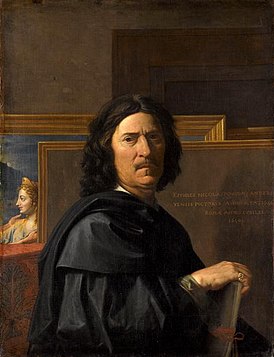
They called him the painter-philosopher. He lived in Rome and wrote letters to Paris — long, intelligent letters about what painting is and what it is for. He thought of a picture as a discourse: it must have a theme, a structure, an argument.
Nicolas Poussin was born in 1594 in Normandy. He came to Paris and for a long time could find no footing. In 1624 he reached Rome — and stayed there almost for good. Rome gave him what his mind required: antiquity, marble gods, philosophy in stone.
He worked slowly and exactingly. He modeled little wax figures of his characters, arranged them into scenes, studied the fall of light. A painting, for him, was not an inspiration but the solving of a problem.
The Arcadian Shepherds: in Arcadia, the ideal pastoral paradise, shepherds have found a tomb bearing the inscription "Et in Arcadia ego" — "I too was in Arcadia." Who is this "I"? Death. Even in paradise there is death. Poussin painted it twice, in 1627 and in 1638.
In 1640 the court summoned him to Paris as first painter to the king. He went, endured two miserable years amid intrigue and courtly commissions, and fled back to Rome.
In his last years his hands trembled. He went on painting — and one can see the brush shaking. It lent his late landscapes a strange softness that the early work never had.
He died in Rome in 1665.