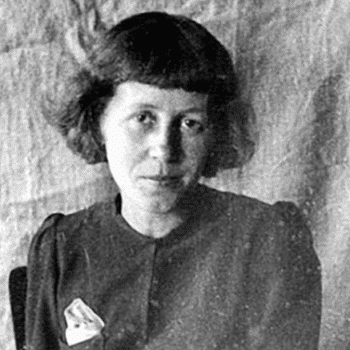
Maria Petrovykh was born in 1908 in Norsky Posad near Yaroslavl, grew up in Moscow, and by the age of thirty already belonged to the narrow inner circle of Russian poetry. Not nominally but in reality: she was read and discussed by those whose opinion about verse actually meant something.
Petrovykh's official Soviet career was built on translation. She translated from Armenian — Hovhannes Tumanyan, Avetik Isahakyan, other poets of the Caucasus — professionally, with an understanding of how a poem works in another language. It was honest labour, not merely bread. But it occupied the place that in another culture would have been taken by a book of her own.
A translator was permitted more than a lyric poet. Another's voice demanded no political responsibility — it belonged to another time and another people. One's own lyric voice, in the Soviet system of the 1930s to 1950s, existed within rigid limits: intelligible, optimistic, or at the very least not at odds with the official register. Petrovykh's voice was different. It was pure lyric about love, time and loss — a genre the system tolerated only in certain doses.
Anna Akhmatova knew her verses and valued them — which, within a certain frame of reference, amounted to recognition. Petrovykh moved in the same circle: they met, read one another their new work, discussed it. When Osip Mandelstam heard her verses, he spoke of them with rare seriousness.
Petrovykh's own collection appeared only at the end of the 1960s — almost forty years after the beginning of her real poetic work. Until then her verses had circulated in manuscript copies, passed from hand to hand, read aloud — but were not printed. Not because she was afraid, but because there was nowhere to bring such a text within official literature.
After her death in 1979 several more books came out — and only then did the full scale of what she had written become visible. Four decades of work that had existed in parallel to official Soviet literature, without ever intersecting with it.
Petrovykh is one example of how the Soviet system could reduce poets to zero not by repression but by irrelevance. She was not arrested. She was simply not printed. For the wider reader she appeared only posthumously — a voice that had walked alongside the whole of the twentieth century, but was heard only by those who searched for it deliberately.