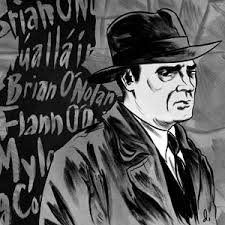
Brian O'Nolan was born in 1911 in Strabane, County Tyrone. He studied at University College Dublin, where he specialized in Irish and German. After his studies he entered the civil service — the Irish Department of Local Government — and worked there for eighteen years. In parallel, under three different names, he created one of the most unusual bodies of writing of his time.
"At Swim-Two-Birds" (1939) was a metanovel before the word came into common use. A student writes a novel whose characters realize that they are characters and begin to sit in judgment on their author: they find him irresponsible, an abuser of his power over them, and put him on trial. The structure has three narrative layers, each commenting on the next. James Joyce read the manuscript and wrote a laudatory note to the publisher Longmans in London. The edition came out — but in 1940 the publisher's warehouse burned down during a German bombing raid. The book appeared again only in 1960: twenty years later it was at last read.
"The Third Policeman" was written around 1940, rejected by several publishers, and lay in a drawer until the author's death. It was published in 1967, posthumously. It is a novel about a murderer who has died and at first fails to understand it — he wanders through a strange Irish landscape where the policemen are absorbed by the theory that riding a bicycle for long enough gradually turns a man into a bicycle (and the other way around). The philosophical treatises of the invented scholar de Selby accompany the text in elaborate footnotes. It is absurdism written with deadly seriousness.
In 1941 O'Nolan published in the Irish language "An Béal Bocht" ("The Poor Mouth") under the name Myles na gCopaleen. It is a parody of the genre of the Irish peasant confession — a memoir of unending poverty, of feats in the name of Ireland, and of the triumph of the language over circumstance. The novel mocked the self-infatuation of the Irish Gaelic revival, its pretension to a special suffering and a special purity. In Irish-language circles the humor was not appreciated.
From 1940 O'Nolan wrote for the "Irish Times" a column called "Cruiskeen Lawn" ("The Overflowing Little Jug"), which ran almost until his death. It was a mixture of satire, absurd logic, linguistic play, and attacks on Irish intellectuals, officials, and politicians. The column was read and feared. O'Nolan left the civil service in 1953 and concentrated on literature and journalism.
The last years of his life were hard. Drink took its toll. "The Dalkey Archive" (1964), the last novel published in his lifetime, used part of the material of "The Third Policeman" and introduced Joyce as a character — portrayed there most unflatteringly: a living Joyce hiding in a seaside village and ashamed of "Ulysses." O'Nolan died on April 1, 1966.
"At Swim-Two-Birds" today stands alongside "Ulysses" as one of the key texts of Irish modernism. "The Third Policeman" regularly appears on lists of the best novels of the twentieth century — though in the author's lifetime it was rejected. O'Nolan invented metafiction, absurd police fiction, and the deconstruction of the Irish idealization of poverty — all this in the 1940s, all this in a desk drawer or under pseudonyms. Such things, too, happen to those who were first.