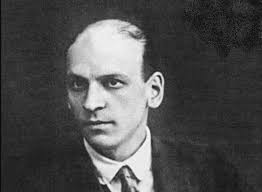
Vladimir Ivanovich Narbut, Russian poet, prose writer and critic, came of an old princely family with Lithuanian roots, the second of nine children. He took a gold medal at the classical gymnasium in Glukhov, but an illness suffered in 1905–06 left him permanently lame: the heel of his right foot had to be removed. From 1906 he lived in St Petersburg with his brother Georgy in the flat of Ivan Bilibin, who exercised a great influence on both young men. At St Petersburg University he passed through three faculties in turn — mathematics, Oriental languages, philology — without finishing any of them, spending his summer holidays at his parents' home and earning money as a tutor.
He appeared in print in 1908 with an essay on the Solovetsky Monastery in the St Petersburg journal Bog — pomoch'! (God Speed!); his first poems followed that December in Svetly Luch (Bright Ray). From early 1911 he contributed verse and criticism to the student journal Gaudeamus, where he also ran the poetry section. Attending the gatherings of young poets at Sergei Gorodetsky's, he drew close to the circle from which the Guild of Poets would soon emerge, and joined the Guild at its founding in October–November 1911, becoming an adept of the nascent doctrines of "Adamism" and Acmeism. In October 1912, to escape prosecution over his scandalous collection Alleluia, he attached himself — with Nikolai Gumilyov's help — to a five-month ethnographic expedition to Somalia and Abyssinia. Returning in March 1913 under the amnesty marking the tercentenary of the Romanov dynasty, he took over the publishing and editing of the New Journal for Everyone, but within two months, entangled in its finances, sold his rights to it and soon left for home.
During the war years he published from time to time in the metropolitan and local press. By 1917 he had joined the Left Socialist Revolutionaries; after the February Revolution he entered the Glukhov soviet, inclining toward the Bolsheviks. In January 1918 the family home was attacked by a detachment of Red "partisans" out to smash "landowners and officers". Vladimir's brother Sergei, an officer recently returned from the front, was killed; Vladimir himself took four bullets, and at the local hospital his left hand had to be amputated. When it emerged that the gravely wounded man of letters was a member of the Bolshevik party, his attackers called at the hospital to offer their "apologies".
In the spring of 1918 he was sent to Voronezh to organize the Bolshevik press, meanwhile bringing out, in 1918–19, the "non-party" journal Sirena. In 1919 he lived in Kyiv, where he had a hand in publishing the journals Zori (Dawns), Krasny Ofitser (Red Officer) and Solntse Truda (Sun of Labour). He stayed on after the Whites took the city, then made his way through White-held territory via Ekaterinoslav to Rostov-on-Don, where on 8 October 1919 he was arrested by White counterintelligence as a communist editor and a member of the Voronezh provincial executive committee. Under interrogation he professed his hatred of the Bolsheviks and explained his collaboration with the Soviet regime by penury, fear and despair — a confession that later fell into the hands of the Cheka and, many years on, in 1928, was used against him as compromising evidence. Freed in a raid by Red cavalry, he formally rejoined the party.
In 1920 he headed the Odessa branch of ROSTA and edited the journals Lava and Oblava, striking up friendships with Eduard Bagritsky, Yuri Olesha and Valentin Kataev — who would later portray him, under the nickname "the gimpy one", in his novel My Diamond Crown. In 1921–22 he ran UkROSTA in Kharkov. Moving to Moscow in 1922 to work in the Commissariat of Enlightenment, he withdrew from poetry. He founded and directed the publishing house Zemlya i Fabrika (Land and Factory), and on its base in 1925, together with the publisher V. A. Reginin, launched the monthly Thirty Days. From 1924 to 1927 he served as deputy head of the Press Department of the Party's Central Committee, and in 1927–28 was among the leaders of VAPP, the proletarian writers' association. In 1928 he was expelled from the party for concealing the circumstances of his time in the south during the civil war, and dismissed from his editorial posts at the same stroke. He lived thereafter by literary hackwork, returning to poetry in 1933.
On 26 October 1936 he was arrested by the NKVD on a charge of propagating "Ukrainian bourgeois nationalism". The investigation assigned him to a "group of Ukrainian nationalists — literary workers" allegedly engaged in anti-Soviet agitation: its declared ringleader was I. S. Postupalsky, its members — besides Narbut — the translators P. S. Shleiman (Karaban) and P. B. Zenkevich and the literary scholar B. A. Navrotsky. On 23 July 1937 a Special Board of the NKVD sentenced each of the five to five years' imprisonment under articles 58-10 and 58-11 of the criminal code. That autumn Narbut passed through a transit camp near Vladivostok, and in November was shipped to Magadan. On 2 April 1938, at the height of the mass terror in the Kolyma camps (December 1937 – September 1938) remembered as the "Garanin terror", a new case was opened against him for counterrevolutionary sabotage. He was interrogated on 4 April; the indictment and the resolution of the NKVD troika were drawn up on the 7th; on 14 April he was shot at quarantine-transit point No. 2 of the Dalstroi trust. In the 1960s a legend gained wide currency that Narbut, along with several hundred invalid prisoners, had been drowned on a barge in Nagaev Bay. For decades the story could not be checked, because at his rehabilitation in October 1956 his relatives were issued a certificate bearing a deliberately falsified date of death — 15 November 1944. The true circumstances of his end were established only at the close of the 1980s.