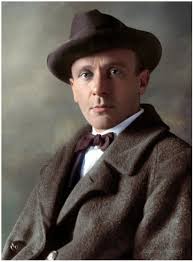
Mikhail Afanasyevich Bulgakov was born in Kyiv in 1891, into the family of a professor at the Kyiv Theological Academy. His father died of nephrosclerosis when Bulgakov was sixteen; of the same illness Bulgakov himself would later die. Bulgakov graduated from the medical faculty of Kyiv University in 1916 and worked as a rural doctor in Smolensk province. The morphine with which he eased his patients' pain became his own addiction — he rid himself of it on his own. Later this experience went into the novella "Morphine" (1927).
In 1921 Bulgakov came to Moscow — without money, without connections, with a firm intention to become a writer. He worked for newspapers, wrote feuilletons and reportage, and composed pieces for cabaret. His first novel, "The White Guard" (1924–1925) — about a cultured Kyiv family in the days of the Civil War — remained unfinished because the journal "Russia" was shut down. But the novel became a play. The Moscow Art Theatre staged "The Days of the Turbins" in 1926: the White Guards here are portrayed as living people with honor and dignity, not as enemies. This made the play inconvenient. It was banned and permitted by turns, yet Stalin watched it again and again — by various accounts, no fewer than fifteen times.
In 1925 Bulgakov wrote the novella "Heart of a Dog" — about Professor Preobrazhensky, who transplants a human pituitary gland into a dog named Sharik. Sharikov turns into a Soviet official: crude, self-satisfied, denouncing the professor. In the USSR the novella was published only in 1987. In 1926 the manuscript was confiscated during a search and returned several years later.
In 1930 Bulgakov burned the first version of "The Master and Margarita" and wrote a letter to the Soviet government. A few weeks later Stalin telephoned him. "Do you want to leave?" Stalin asked. Bulgakov said that a Russian writer cannot live outside his homeland. He was offered a post as assistant director at the Moscow Art Theatre — and he worked there to the end of his life, continuing to write in parallel.
"A Theatrical Novel" ("Notes of a Dead Man") is an unfinished satire of the theatrical world, in which both the Moscow Art Theatre and Stanislavsky can be discerned. The play "The Cabal of Hypocrites" ("Molière," 1936) is a story about how power destroys the artist: Louis XIV and Molière. After the sixth performance the play was banned. Bulgakov was published in practically no genre — everything he wrote went into the desk drawer.
"The Master and Margarita" he began anew around 1931 and rewrote until his last days. The novel is built on two temporal layers: Moscow of the 1930s, visited by the devil Woland with his retinue, and first-century Jerusalem, where Pontius Pilate interrogates Yeshua Ha-Notsri. Woland in Moscow puts people to the test — and the results are discouraging. Yeshua tells Pilate that there are no evil people, only unhappy ones. Pilate does not believe this — though, perhaps, he wants to believe. The two plots do not explain each other, but they rhyme: about power, cowardice, and what happens to the truth when it meets the state. The final edits Bulgakov dictated to his wife, Elena Sergeyevna, when he could already barely speak.
Bulgakov died on March 10, 1940. Elena Sergeyevna Bulgakova preserved the manuscript. In 1966–1967 the novel appeared in the journal "Moskva" with censorship cuts. The full text appeared in 1973. By that time it had already been copied out by hand by thousands of readers — who had no other way to read it.