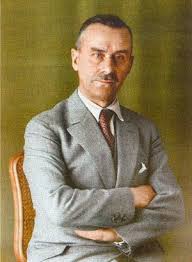
Thomas Mann (1875–1955) was born in Lübeck, into the family of a senator and grain merchant. His mother was half Brazilian — this doubleness (bourgeois duty and sensuality, North and South) he reflected on all his life. Buddenbrooks (1901) tells of four generations of a merchant family: how the fortune is passed down while the will to live ebbs away. At its base is the story of two real Lübeck families, including his own. The novel appeared when he was twenty-five, sold in enormous numbers, and has stayed in print to this day. In 1929 the Nobel committee named it Mann's chief achievement — though by that time he had already written Death in Venice and The Magic Mountain.
Death in Venice (1912) is the story of a writer who travels to Venice to rest and stays because he has glimpsed beauty in the face of a Polish boy, Tadzio. Meanwhile cholera is in the city; the authorities conceal it from the tourists. He knows — and does not leave. Mann wrote the novella after a real journey: a real hotel, a real boy, a real epidemic. It is about how aesthetic rapture dissolves the moral will — not through evil intent, not by choice, it simply dissolves it.
The Magic Mountain (1924) was conceived as a short novella to counterbalance Death in Venice and swelled to a thousand pages. The young engineer Hans Castorp travels to a sanatorium near Davos for three weeks to visit his cousin — and stays for seven years. The "Berghof" sanatorium is a model of prewar Europe: here the humanist Settembrini and the Jesuit-Marxist Naphta argue, here people die slowly and as if with pleasure, here time flows differently. When the First World War breaks out, Hans goes off to the front — the novel breaks off without an answer. Mann wrote the book for ten years. The Europe he was describing vanished while he wrote.
On 10 February 1933 Mann delivered a lecture in Munich, "The Sufferings and Greatness of Richard Wagner" — German nationalists had already organized a protest against it. A few days later he left on a lecture tour and did not return. His family got out later. They lived in Basel and Zurich; in 1938 they moved to Princeton, then to Pacific Palisades near Los Angeles. In 1944 Mann received American citizenship. In 1936 his German citizenship was taken from him and his honorary doctorate from the University of Bonn annulled — he replied with an open letter to the dean that became a document of the age.
From 1940 to 1945 Mann recorded addresses to German listeners — "Deutsche Hörer!" ("German Listeners!"). They were broadcast via the BBC to occupied Europe and to Germany itself. Several dozen broadcasts — about what Germany had become and what it might still be, about the meaning of the war, about the responsibility of culture. Mann would not allow himself to hate the German people, only the regime. It is unknown how many Germans heard these words; it is known that they existed.
Doctor Faustus (1947) is a novel about a German composer, Adrian Leverkühn, who strikes a bargain with the devil in exchange for twenty-four years of genius. Mann called it the most personal and the most difficult of his works. In it he dissected Germany as a Faustian bargain: a brilliant culture, for the sake of which humanity is sacrificed, ends in catastrophe. Leverkühn ends in madness — like Nietzsche, whose shadow stands behind the whole novel. It was written from 1943 to 1947, in California, as the scale of what had happened came to light.
In 1949 Mann came to Germany twice: to Frankfurt — to receive the Goethe Prize — and to Weimar, on either side of the nascent Iron Curtain. The German press attacked him for the visit to Weimar. Mann answered that German culture is not divided into western and eastern. He never did move back — he lived in Kilchberg near Zurich, where he died in 1955. His brother Heinrich Mann died in California in 1950, never having returned. The German culture of the twentieth century became, to a considerable degree, a culture of exiles — and Thomas Mann embodied this more precisely than others.