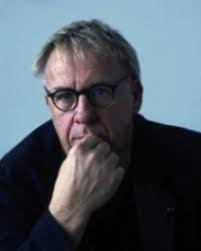
Joseph Kosuth was born on January 31, 1945, in Toledo, Ohio. From 1955 to 1962 he studied at the art school of the Toledo Museum of Art, and also took private lessons from the Belgian painter Line Bloom Draper. In 1963 he entered the Cleveland Institute of Art, and spent the following year in Paris and traveling through Europe and North Africa.
In 1965 Kosuth moved to New York and enrolled at the School of Visual Arts; later, from 1968, he taught there himself. In that same year, 1965, while still a student, he created the work that secured him a place in the history of art — the installation "One and Three Chairs."
Its arrangement is utterly simple: an ordinary wooden chair, a photograph of that same chair as it stands in a particular room, and an enlarged copy of the dictionary definition of the word "chair." According to Kosuth's design, the photograph is to be remade anew for each new place of exhibition — so that the picture exactly matches the real chair standing beside it. The viewer is invited to compare the thing, its image, and its concept, and to decide for himself which of the three is closest to what he calls a "chair" — and, at the same time, to what can be called art at all.
The idea did not come out of nowhere: Kosuth himself directly named Marcel Duchamp as his chief predecessor, who back in 1917 exhibited a porcelain urinal under the title "Fountain" and thereby showed that the status of art is determined not by the master's hand but by the decision and the context. Kosuth carried this gesture to the utmost clarity, adding to the thing its image and its verbal definition — as if illustrating the very logic by which an object becomes a work of art.
Four years after this work, Kosuth published the programmatic text "Art After Philosophy" (1969), in which he formulated the central thesis of conceptualism: all art after Marcel Duchamp is conceptual in nature, because it exists not in the physical object but in the idea that the object conveys. Painting and sculpture, in his view, had ceased to be the privileged way of raising questions about art — a text can serve this purpose, or a photograph, or any object placed in the right context.
This position made Kosuth one of the chief theorists and practitioners of the conceptual art of the second half of the twentieth century — a movement in which the value of a work is measured not by the skill of its execution but by the precision and sharpness of the thought it provokes. "One and Three Chairs" has since been held in the collection of the Museum of Modern Art in New York and remains one of the most frequently reproduced illustrations of the very notion of conceptual art — in textbooks, in lectures, in countless student retellings of the history of twentieth-century painting, which for Kosuth had ceased to be the history of painting alone.
Tellingly, the work itself is arranged so that each new exhibition changes it physically — a new chair, a new re-photographing — but does not change its meaning: what matters is not the particular thing but the relation between thing, image, and word. In this way Kosuth deprived his most famous work in advance of what the value of painting is traditionally measured by — the uniqueness of the brushstroke and the irreproducibility of the original — and offered in its place an idea that can be reassembled anew anywhere in the world without losing a drop of meaning.