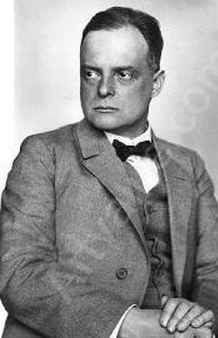
Paul Klee (18 December 1879, Muenchenbuchsee, Switzerland – 29 June 1940, Locarno, Switzerland) was a German artist, a theorist of the avant-garde, a member of the Blue Rider group and a teacher at the celebrated Bauhaus.
Though he belonged to major artistic movements, Klee remains a singular artist whose painterly searching cannot be confined to any one school. Experiments with every kind of technique, the invention of a pointillism all his own — pictures built of many-coloured squares — the dream of growing a painting the way one grows a plant, the ambition to convey the greatest movement with the fewest means: Klee painted almost nothing that was wholly abstract. His quest was to look at something tangible and definite from within and from every side at once — a search for its exhaustive essence.
Among his best-known paintings are Twittering Machine, Angelus Novus, Revolution of the Viaduct, Cat and Bird, and Highway and Byways.
Klee is an almost unprecedentedly good man in the history of art. He spent his whole life with one woman; in the evenings he played duets with Kandinsky, one at the violin, the other at the piano; to his son Felix he was a splendid father and a discoverer of enchanted worlds. During the First World War he did not shoot: he stayed behind the lines painting camouflage onto aeroplanes. He was an inspiring teacher whose students listened with bated breath; at the Bauhaus they called him the Buddha. He was luminous, calm, sparing with words, and never desperately angry at anyone.
Klee was the first artist to call the drawings of children and of the mad genuine art — some ten years before the first books on the subject began to appear. He was a theorist of art who knew how to be utterly unserious when speaking of what mattered most: an intellectual and a visionary, without contradiction. He was convinced that the material, visible world is only one of the worlds open to man. And then Klee lay dying of a terribly material disease, scleroderma, which brought pain with every movement — as if this world wished to become the only one in his life at last, to make him drop anchor here and search for other worlds no longer. He could barely leave his bed, yet in that final, hardest year of his life he produced a record number of works: twelve hundred. To the devil with anchors! So, in effect, his grandmother had said.
Well — she did not say "to the devil," and perhaps nothing about anchors either; she simply wrested little Paul from the other adults and insisted that he be allowed to write and draw with his left hand. It was she who first slipped coloured chalks to her grandson and let him depict whatever he pleased, with both hands at once. Many years later that trick of Professor Klee's with the two hands would more than once leave the Bauhaus students open-mouthed. His childhood drawings Klee would later carefully paste onto cardboard, title, and enter into the catalogue of his works that he kept all his life.
After that, Paul had to fend off the world himself. Although at eleven he received a special invitation to play violin in the Bern musical academy, by nineteen he had managed to persuade his musician parents that his place was not in an orchestra: his business was painting. After studies at the Munich Academy of Arts and the trip to Italy traditional for every young painter, he returned to Bern, drew a great deal, read works of theory, and went on earning his living the proven way — in the municipal orchestra.
The violin he never abandoned; he loved to play before taking up the brush — it tuned him. There is something fitting and even inevitable in the fact that the artist's wife was a pianist. Lili Stumpf was a virtuoso musician, an excellent teacher and a remarkable wife. After their marriage in 1906 it was she who earned the money, and even after the birth of their son Felix in 1907 — still she. Even now, in an age of nearly triumphant feminism, such a division of labour in a family can hardly be called usual; at the start of the twentieth century it was a genuine upheaval, and gave Freud's followers matter for barbed psychoanalysis. Felix, meanwhile, was one of the happiest boys in the universe. While his mother worked, his father fed him, did the shopping, and made him a theatre. The fifty puppets Klee created for his son's home stage — with faces of plaster and metal, in fantastic costumes, comic and frightening — are now included in the artist's grandest exhibitions. Felix Klee, grown up, remembered: "My puppet theatre turned me into a magician who had success with everyone, young and old" — and became a theatre director.
Once in Germany, Klee found at last the artistic company he needed: the Blue Rider, Wassily Kandinsky, Franz Marc, Robert Delaunay, whose essay "On Light" Klee translated into German. Soon there was no time left for household duties at all.
Klee was the first to devise automatic drawing, for which the Surrealists would later enrol him among their forerunners; he invented singular techniques such as scratching a design into darkened glass, for which he was soon called to teach at the avant-garde Bauhaus. For him the process of making was always more important than the finished result, becoming more important than recognition. Klee was born as an artist slowly, and with relish.
A superb draughtsman, alert to the shifting forms of the world around him, Klee nonetheless long failed to master oil paint and make colour live in his pictures — until he went to Tunisia. That journey of 1914, made after several solo exhibitions, after the second Blue Rider show and the First German Autumn Salon at the Sturm gallery, at last set free in Klee the artist who would remain free all his life — free of isms, free of the influence of colleagues and masters, always unexpected even in relation to the Klee of the year before.
Exactly such a teacher was needed at the Bauhaus, the most revolutionary and avant-garde school for artists in all Europe, which saw the artist's aim not as the decoration of the world but as its transformation. For ten years Klee led its workshops in stained glass, textiles and bookbinding, wrote several theoretical works published in the Bauhaus Books series, and raised several generations of artist-craftsmen who took from Klee one essential skill: not to imitate their teacher blindly, but to have the courage to be free.
In the early thirties Klee left the Bauhaus without waiting for its imminent closure — only to become, briefly, a professor at the Duesseldorf Academy, to meet armed men in his studio who came to conduct a search and in the end drove the dangerous artist from the academy, from the city and from the country. In Switzerland, where Klee went, there was almost no artistic life; most of his colleagues had emigrated to America, some to the Soviet Union. He would never again have a studio of his own — but then, in the larger sense, he had never really needed one.
He dreamed of one day growing a work of art like a plant. He knew how to talk to snakes, and they obeyed him. Walking in a park, he could feel himself part of the universe, like a leaf or a cat. He remained a man without earthly citizenship, a ship without an anchor, and received Swiss citizenship only a week after his death. But by then Klee was already far from Switzerland.