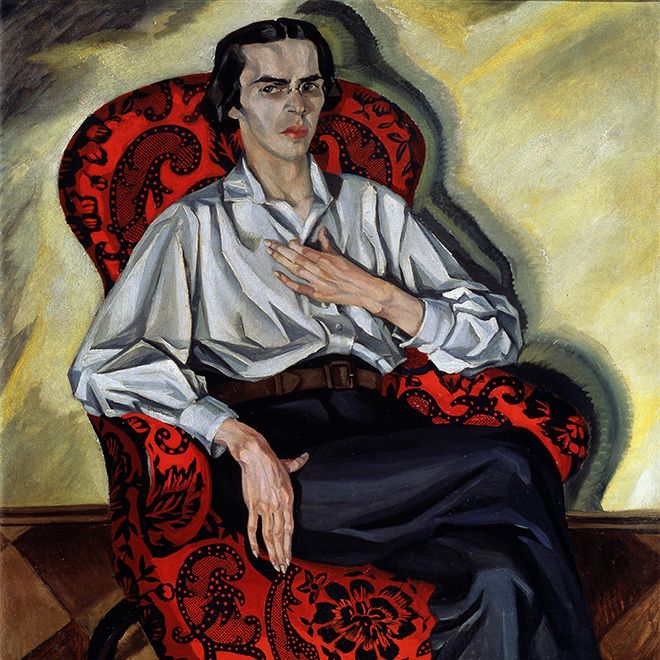
Vladislav Khodasevich (1886–1939) was born in Moscow. His mother was of Polish descent; his father was a converted Jew who worked as a photographer. Khodasevich always felt himself a man of several shores: not quite Russian, not quite Polish, not quite Muscovite. He studied at the Faculty of History and Philology but never completed his degree. Yet he came early to understand that Pushkin was for him not merely a classic author but a personal problem demanding resolution.
He stood close to the Symbolists — he frequented the "Tower" of Vyacheslav Ivanov and was on friendly terms with Bryusov — yet he never became a Symbolist himself. He kept his distance: he valued clarity of the word too highly to drown in the mists of Symbolism. His first three collections passed almost unnoticed. The Grain's Way (1920) began to draw attention. Heavy Lyre (1922) made his name.
Heavy Lyre is a book about homelessness — not political homelessness, but metaphysical. Its hero stands between two worlds: the carnal and the spiritual, the living and the dead, Russia and whatever lies beyond it. The poems are written in classical iambs — deliberately, provocatively old-fashioned against the backdrop of the revolutionary avant-garde. Khodasevich was not afraid to appear archaic. He believed that only traditional form was capable of holding together what would otherwise fall apart.
In 1922 he left Russia together with Gorky — officially as his secretary, in essence as his guest. Berlin, Prague, Paris. When in 1925 it became clear there was no returning, he remained abroad for good. He became a critic for the newspaper Vozrozhdenie (Renaissance) — the principal literary reviewer of the Russian emigration. His position was a strict one: fidelity to classical tradition, precision of language, distrust of experimentation for its own sake. He was feared. He was read.
His verse all but ceased in 1927. Khodasevich explained this in various ways: no strength, no language, no air. Nabokov later said that Khodasevich was too honest to write in half a voice — that silence was preferable to compromise. In this sense, his muteness was itself a position.
In parallel he worked on a major book about Pushkin — one he never finished. Of what he managed to complete: The Poetic Economy of Pushkin (1924) and Derzhavin (1931), a biography of the eighteenth-century poet that became a model of the genre within the Russian emigration. In 1939 he died of cancer in a Paris hospital. There was almost no money in his account. Shortly before his death he dictated his memoirs of the Symbolists — Necropolis: the book appeared in the year of his death.
Nabokov wrote an obituary in which he called Khodasevich "the greatest poet of our time" and "a model of integrity in an age of slovenliness." In Soviet Russia, Khodasevich's name was under a ban; the first complete collection of his poems appeared in 1961 in New York — twenty-two years after his death. Russia itself caught up with him later still. He never learned that he had been right about form.