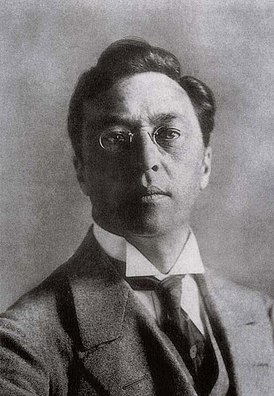
In 1910 he walked into his studio and saw on the wall a picture of improbable beauty. He could make out no forms — only colours and lines. He stepped closer. It was his own painting, standing on its side.
Kandinsky described the moment in his memoirs as a revelation: so the depiction of a real object was not necessary after all. Colour and form by themselves could stir the emotions — the way sound does in music. Thus abstract painting was born.
Wassily Kandinsky was born in Moscow in 1866. He took a degree in law and was appointed to a professorship. At thirty he abandoned everything and left for Munich to study painting.
He thought a great deal about the bond between colour and sound. Yellow was like a trumpet; blue, like a cello. He had synaesthesia: he saw colours in sounds and heard sounds in colours. His paintings bear the titles Composition, Improvisation, Impression — the vocabulary of music.
After the revolution of 1917 he returned to Russia and took part in Soviet cultural projects. But the Soviet state cared less and less for abstraction, and more and more for agitational realism. In 1921 he left for Germany, for the Bauhaus.
In 1933 the Nazis closed the Bauhaus. Kandinsky moved to Paris, where he lived until his death in 1944. The Nazis declared his paintings "degenerate art" and burned them.
He outlived two world wars, two revolutions and two regimes that had declared him an enemy. He went on painting coloured circles.